Client Approval Time Benchmarks for Agencies
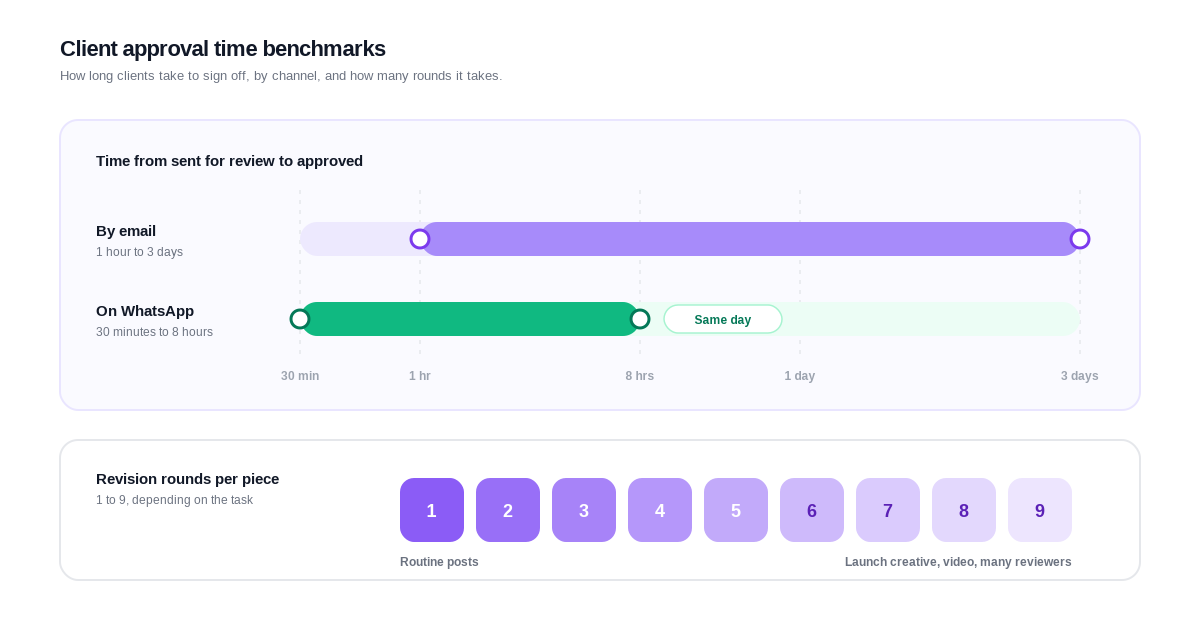
How long should a client take to sign off a post? Across the agencies we work with, client approval time runs from 1 hour to 3 days when the request goes by email, and clients in WhatsApp-first markets usually approve the same day. These client approval time benchmarks cover approval turnaround and revision rounds, what pushes a client to either end, and the changes that pull the wait down.

What a Slow Approval Really Costs an Agency
The wait is the visible part. The damage happens around it.
Posts Miss the Moment They Were Made For
01A post written for a Friday product drop gets approved on Monday. It still goes out, but the reason it existed is gone. Timely content has a shelf life, and every day a draft sits in a client's inbox eats into it. On a content calendar with 20 clients, a handful of three-day waits each week is enough to push the whole plan out of sync.
Work Goes Cold While It Waits
02By the time feedback arrives three days later, the designer has moved on to four other clients. Picking the piece back up means re-reading the brief, finding the file, and remembering why the headline was written that way. The revision itself takes ten minutes. Getting back into it takes longer.
Feedback Arrives in Pieces
03The marketing manager replies on Tuesday, the founder adds a comment on Thursday, and the second note contradicts the first. Each partial reply starts a new round. A lot of the high revision counts we see are not picky clients. They are several approvers giving feedback one at a time.
Late Approvals Get Blamed on the Agency
04When a campaign slips, the client rarely remembers that the draft sat unread for two days. They remember that the campaign was late. Without a record of when content was sent and when it was answered, the agency absorbs the blame, and it shows up later in client retention conversations.
Client Approval Time and Revision Benchmarks
The ranges we see across agency teams in 2026, and what moves a client within them
Approval by Email: 1 Hour to 3 Days
When the review request lands in a client's inbox, the answer can come back within the hour or three days later. The spread has little to do with how much the client cares. It tracks how often they open email during the working day and how many other approvals are already waiting for them.
- Fast end: owner-led brands, one approver
- Slow end: travel, meetings, busy season
- Requests sent late Friday often wait for Monday
- Reminders pull the slow end in
Approval on WhatsApp: 30 Minutes to 8 Hours
In markets where business runs on WhatsApp, such as the UAE, Saudi Arabia and India, clients answer review requests much faster. Most approvals come back the same working day, often within the first hour. The client is not more diligent. The request simply arrives in the app they already have open.
- Typical result: same-day sign-off
- Fast end: around 30 minutes
- Slow end: about one working day
- Works best with a link that opens on a phone
Revision Rounds: 1 to 9 per Piece
How many rounds a piece goes through depends mostly on the task. A routine post with a clear brief often clears in one round. Launch creative, video and anything reviewed by several people at the client can run to the high single digits before everyone signs off.
- Routine posts: low end of the range
- Campaign and launch creative: higher
- More approvers, more rounds
- Vague briefs add rounds at the end
Availability Sets the Pace
The single biggest variable in client approval time is whether the approver is around. A founder who approves from their phone between meetings answers in an hour. A marketing director with three layers of internal review answers when their own week allows. Knowing which type each client is lets you plan deadlines around them, and it is worth capturing during workspace setup along with the account manager for each client.
- Ask who approves at onboarding
- Note each client's usual response day
- Plan time-sensitive posts with a buffer
- Name one final approver per client
Number of Approvers Multiplies Rounds
One approver gives one set of feedback. Three approvers give three sets, usually at different times, and often in conflict. The fix is not more chasing. It is agreeing who consolidates feedback on the client side before it comes back to you, and making that person the only one who can approve. A written approval process does the rest.
- One consolidated reply per round
- A named final decision-maker
- Feedback on the draft, not in email threads
- Revision history shows who asked for what
Friction Adds Hours
Every extra step between the client and the approve button adds time, which is why client portal software is judged so heavily on how easy the client side is. A login screen, a password reset, a PDF attachment to download, a separate email to write. Clients put off approvals that feel like work. When reviewing takes a tap and a comment, it gets done in the gap between meetings.
- No account or password for the client
- Review on mobile, in the browser
- Approve or request changes in one step
- Feedback attached to the post itself
How to Reduce Client Approval Time
Four changes that move most clients toward the fast end of the range
Measure Your Own Baseline
For the next month, note when each piece is sent for review and when the client decides, plus how many rounds it took. Track it per client, not as one agency average. You will usually find that two or three clients cause most of the waiting, which tells you where to start.
Send the Request Where the Client Already Is
If a client lives in email, send it by email. If they live on WhatsApp, put the review link in the WhatsApp chat. A shareable review link that needs no login opens in the phone's browser wherever it is pasted, so the channel can follow the client instead of the other way round.
Agree a Review Window and a Revision Limit
Put both into the proposal, the social media contract or the onboarding notes: how long the client has to review, and how many revision rounds the fee includes. For routine content, an optional auto-approve deadline stops a quiet client from blocking the calendar. Sensitive posts can still wait for an explicit yes.
Let Follow-Ups Run Themselves
Chasing approvals by hand is where account managers lose their afternoons. Automated reminders and a clear queue of what is waiting on whom do the nagging for you, and the record of every send and reply settles any argument later about why something was late.
Approval Turnaround in Practice
Illustrative scenarios built from patterns we see, not individual client results
Dubai Social Agency
Nine retail and hospitality clients, review requests sent by emailApprovals took anywhere from a few hours to three days. Account managers spent part of every morning re-sending emails and checking whether the client had opened the last one. Weekend promotions were often approved too late to schedule properly.
The agency started pasting the no-login review link into each client's WhatsApp chat. Most clients now open it within the hour and approve or comment from their phone. Email is kept for the two clients who prefer it.
Content Studio With Multi-Stakeholder Clients
Launch campaigns for B2B clients where marketing, product and legal all reviewCampaign creative regularly went through seven to nine rounds. Each reviewer replied separately by email, often days apart, and later comments undid earlier ones. Nobody could say which version had been agreed.
Each client now names one person who gathers internal feedback and sends a single reply per round, with feedback left on the review page itself. The contract includes three rounds for campaign creative, with extra rounds billed.
Small Agency With Quiet Clients
A three-person team running always-on content for local businessesTwo clients rarely answered at all. Posts sat in review for days, and the calendar for those clients was always behind. The founder ended up approving things informally over the phone with no written record.
Routine posts for those clients go out on an auto-approve deadline with reminders while the window is open. Anything sensitive still waits for a written yes. The revision history shows exactly what was sent and when.
Client Approval Time Benchmarks at a Glance
The ranges we see across agency teams, and what decides where a client lands.
| Measure | Typical range | Fast end looks like | Slow end looks like |
|---|---|---|---|
| Approval by email | 1 hour to 3 days | One approver who checks email through the day | Busy approver, several reviewers, Friday sends |
| Approval on WhatsApp | 30 minutes to 8 hours | Owner approves from their phone between meetings | Still the same working day in most cases |
| Revision rounds | 1 to 9 per piece | Routine post with a clear brief | Launch creative or video with several stakeholders |
These ranges come from the agencies we work with, not a formal study. WhatsApp-first markets here means places like the UAE, Saudi Arabia and India, where clients run day-to-day business on WhatsApp.
Why Approval Turnaround Varies So Much
It is mostly about when the client sees the request
When we look at why one client signs off in an hour and another takes three days, the content is rarely the reason. The difference is when the request reaches someone who can say yes. An owner-run brand with one decision-maker who keeps their phone close answers quickly. A larger client whose marketing lead batches approvals once a week answers on that day, whatever you send. This is the same pattern we found with social media response time benchmarks: the delay sits in the gap before anyone looks, not in the work itself.
Same client, different channel, same-day answer
In WhatsApp-first markets we routinely see approvals land between 30 minutes and 8 hours, against 1 hour to 3 days when the same kind of request goes by email. Moving the request to the app the client already has open is the cheapest speed-up available.
Revision counts follow the task, and the number of voices
A count of 1 to 9 rounds sounds like a wide range, but it splits fairly cleanly. Routine, always-on posts sit near the bottom. The top of the range almost always involves one of a few things:
- Several reviewers replying separately. Each partial reply starts a new round, and later comments often reverse earlier ones.
- A brief that was settled after the draft. The client discovers what they wanted by seeing what they did not want.
- High-stakes creative. Launches, video and paid campaign assets get more scrutiny, and fairly so.
- Feedback scattered across email, chat and calls. Notes get missed, so the same change is requested twice.
Most of these are process problems, which is good news, because process is something the agency controls. A clear content approval workflow for agencies with one named approver per client removes the first and last causes almost entirely. For design-heavy work, dedicated creative approval, where feedback is attached to the piece being reviewed, stops it from scattering in the first place.
What we recommend as targets
These are not measured averages. They are the targets we suggest agencies agree with clients, based on the ranges above:
- Routine posts: a decision within one working day, and no more than two rounds.
- Campaign or launch creative: a review window of two to three working days, with the included rounds written into the scope.
- Time-sensitive posts: sent at least two working days before they need to go live, so even a slow approval lands in time.
Agree these at onboarding, alongside who approves for the client; our social media client onboarding questionnaire has the exact questions to ask. If you are planning a whole campaign, our marketing campaign plan template has room for review dates next to each deliverable, which makes the deadline visible to both sides from day one.
Cutting Client Approval Time Without Chasing
Make approving take one tap
The biggest single improvement is removing every step between the client and the approve button. In CampaignSwift, content goes out on a no-login review link: the client opens it, sees the post, and approves or requests changes. There is no account to create, which is exactly why it works when pasted into a WhatsApp chat as well as an email. The review page carries your agency's logo, so it doubles as a lightweight client portal without logins, and our page on the white-label client portal covers how far the branding goes.
Keep every round on the record
Every version and decision is kept in the revision history, so when a client asks why a caption changed, you can show who asked for it and when. That same record answers the harder question of why a campaign went out late. It is one of the reasons agencies move approvals out of email and into proper social media approval software.
Let reminders and deadlines do the follow-up
For routine content you can set an optional auto-approve deadline: the client gets reminders while the window is open, and if they stay silent the post is approved and your calendar keeps moving. The Approval Shepherd agent handles the chasing on top of that. It sends polite follow-ups when an approval stalls, applies small requested fixes like a caption tweak, and hands real direction changes back to your team. You can read exactly what Approval Shepherd will and won't do; it never approves on the client's behalf.
Once a post is approved it is scheduled from the same calendar with social media scheduling, and pending approvals sit together on one approvals screen. If you run many accounts, multi-client management keeps every client in the same workspace. Over a few months, sharing approval turnaround in your agency reporting also helps clients see their own part in hitting deadlines. For the wider picture of running dozens of accounts, see our guide to managing social media for multiple clients. Client approval links and Approval Shepherd are included from the Professional plan, and you can compare everything on the pricing page.
Client Approval Time FAQ
Common questions about approval turnaround and revisions
Across the agencies we work with, a normal client approval time is between 1 hour and 3 days when the request is sent by email. Where in that range a client lands depends mostly on their availability and how many people review on their side. In WhatsApp-first markets such as the UAE, Saudi Arabia and India, most clients approve the same day, typically within 30 minutes to 8 hours.
We see anywhere from 1 to 9 rounds, and the task is the main factor. Routine posts with a clear brief often clear in a single round. Launch creative, video and work reviewed by several stakeholders sit at the high end. If routine posts regularly need more than two rounds, the brief or the feedback process usually needs fixing, not the content.
Because WhatsApp is the app they already have open. In markets where business conversations happen on WhatsApp, a review request there is seen within minutes, while the same request by email joins a queue the client works through when they have time. The client's willingness is the same. The channel changes how quickly they notice.
Measure from the moment the piece is sent for review to the moment the client approves it, and record the number of revision rounds alongside it. Track it per client and per content type rather than as one agency-wide average, and use the median so one forgotten post does not distort the picture. Review the numbers monthly.
Yes. Stating how many rounds the fee includes, for example two for routine posts and more for campaign creative, sets expectations before the first draft goes out. It also gives you a fair basis to bill extra rounds when a project grows, instead of absorbing the time quietly.
Agree a review window up front, send reminders while it is open, and for routine content consider an auto-approve deadline so the calendar keeps moving. Keep explicit approval for sensitive or regulated posts. A written record of when each piece was sent and answered protects the agency if timing is questioned later.
CampaignSwift sends content for review through a shareable link that needs no login, so clients can approve or request changes from any device, including straight from a link pasted into WhatsApp. Every round is kept in the revision history, you can set optional auto-approve deadlines with reminders, and the Approval Shepherd agent follows up on stalled approvals so your team does not have to. Client approval links are included on the Professional plan and above.
Still have questions?
Our team is here to help. Book a 15-minute call to get all your questions answered.
Ready to put the busywork on agents?
Start with one client. Connect accounts, send your first approval link, and let the agents take the follow-ups. Plans start at $29/mo.
30-day free trial · No credit card · Cancel anytime
Questions? Book a 15-min demo call
Schedule Demo