AI Social Media Approval Workflows How They Work in 2026
AI social media approval workflows are reshaping how agencies route content for client sign-off. Instead of chasing pending approvals via email and Slack, an AI approval agent routes content to the right reviewer, chases stuck sign-offs, tracks revisions, and flags what's blocked, proposing actions humans approve with one click. This guide explains how agentic approval workflows actually work, what to evaluate, and which platforms lead the category.

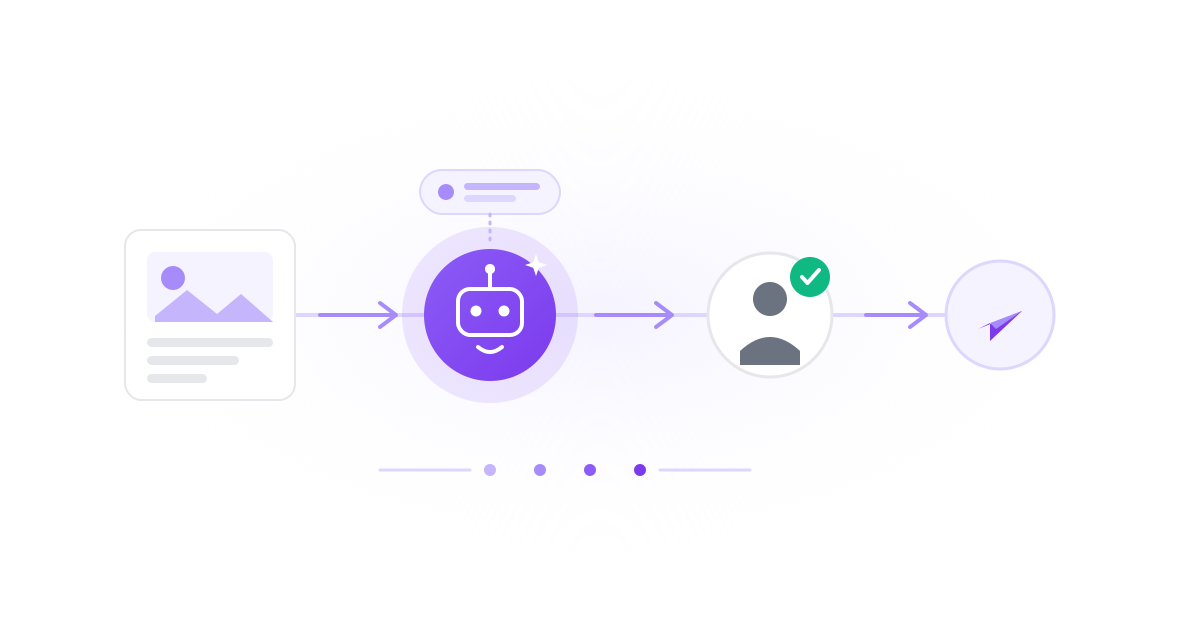
Why Traditional Approval Workflows Break at Scale
The friction agencies hit running 10+ clients through manual approvals
Manual Approval Chasing Eats Account-Manager Hours
01When approvals route through email and Slack, account managers commonly spend 30-60 minutes per client per week chasing sign-offs. At 15 clients, that can mean 8-15 hours of pure coordination work that doesn't move the needle on client growth but absolutely blocks the team from publishing on schedule.
No One Sees What's Stuck Until It's Late
02Without a system actively tracking which approvals are pending, stale items hide in inboxes. A post submitted Monday for Thursday publication often surfaces Wednesday afternoon, too late to recover the original schedule. The agency owns the missed window even though the client caused the delay.
Multiple Stakeholders Create Approval Routing Chaos
03Client-side approvals often involve 2-3 stakeholders: marketing coordinator, marketing director, sometimes the CMO. Each has different SLA expectations. Manual workflows can't enforce sequential routing or auto-escalate when a stakeholder goes silent. Posts get approved by the wrong person or skip required reviewers entirely.
Audit Trail Gets Built in Hindsight (Or Not at All)
04When a client disputes 'I never approved this,' the agency needs a clean audit trail of who approved what, when, and which version. Email chains don't produce that trail cleanly. The same problem hits compliance-sensitive industries (finance, healthcare, regulated brands) where the audit trail is a legal artifact, not just a workflow record.
What AI Approval Agents Actually Do
The agentic capabilities that separate AI approval workflows from basic automated routing
Intelligent Routing: Sends Content to the Right Reviewer Automatically
An AI approval agent reads the content type, client workspace, and approval rules to route each item to the correct reviewer without manual assignment. A static social post goes to one reviewer; a paid ad goes through legal review first; a campaign launch routes through the CMO. The routing engine combines client config, content metadata, and rules, so account managers stop manually assigning every approval request.
- Routes based on content + client rules
- Sequential or parallel review
- Auto-escalation when silent
- No manual assignment overhead
Active Chasing: Pursues Stuck Sign-Offs Without Your Team
This is the differentiator. Traditional approval tools wait passively for a click. An AI approval agent actively chases: it sends a follow-up at hour 24, escalates to a backup stakeholder at hour 48, and surfaces the stuck item as a priority for the account manager. When a client SLA is about to slip, the agent doesn't wait for a human to notice. It proposes an escalation path you approve with one click.
- Automatic follow-up cadence
- Backup stakeholder escalation
- SLA-aware nudges
- Surfaces what's stuck
Revision Tracking: Versions, Comments, and Diff at Every Stage
Every change to an asset creates a tracked version with the author, timestamp, and the specific change. Reviewers see a clean diff against the previous version: what changed, who changed it, and why. Comments attach to specific elements (the caption, a frame in the video, a CTA button) so feedback is contextual rather than free-text floating above the asset.
- Per-element comments
- Version diff view
- Author + timestamp on every change
- Audit trail by default
Blocker Detection: Flags What's Actually Stopping Publication
When a post can't go live, the AI agent identifies the specific blocker: a missing platform-specific asset, a stakeholder who hasn't responded in 72 hours, an approval that's pending but unassigned, a client whose payment is overdue. Instead of 'this post is stuck somewhere,' your team gets 'this post is stuck because [client's brand director] hasn't responded, escalate to [backup]?'
- Specific blocker identification
- Proposed unblock action
- One-click resolution
- Pattern detection across clients
Propose-Then-Approve: AI Drafts, Humans Decide
The core principle of agentic approval is that the AI proposes actions and humans approve. For routine follow-ups, the agent drafts a polite chase message in the client's preferred channel. For blocked items, it proposes an escalation. For content needing minor edits, it drafts the edit. You see the proposal, approve or modify, and the agent executes. Nothing happens without human sign-off on consequential actions.
- AI proposes, human approves
- Drafted chase messages
- Drafted escalations
- Human stays final yes
Audit Trail: Compliance-Grade Sign-Off Records
Every approval, comment, revision, and routing decision lands in a queryable audit log. When a client disputes whether they approved a specific version, the trail shows exactly who clicked approve, when, on which version, with what comments. For regulated industries (finance, healthcare), the audit trail meets compliance requirements without an additional compliance tool.
- Timestamped sign-off records
- Per-version approval history
- Exportable audit log
- Compliance-grade by default
How AI Social Media Approval Workflows Are Built
From submission to publish, every step the agent touches
Content Submitted and Tagged
An asset enters the workflow with its content type (post, ad, video), client workspace, campaign context, and target platforms. The AI agent reads these tags and matches them against the client's approval rules: sequential review chain, required stakeholders, SLA targets.
Auto-Routed to the Right Reviewer
The agent routes to the first required reviewer based on content type and client config. Routine social posts may skip straight to client review; campaign launches route through internal QA, then account manager, then client CMO. Notifications fire on the channel each stakeholder prefers (email, Slack, in-app).
Active Chase if a Reviewer Goes Silent
If a reviewer hasn't acted by the SLA threshold, the agent drafts a polite follow-up message and proposes sending it. Approved by the account manager (or auto-sent based on workflow config), the chase goes out. At the next escalation tier, the agent surfaces the stuck item as a priority for human intervention.
Approval, Revision, or Block
The reviewer either approves (post moves to next stage), requests revisions (item returns to author with comments attached to specific elements), or rejects (workflow ends with documented reason). Every action lands in the audit trail.
Publish When Fully Approved
Once all required stakeholders have approved, the content is locked and scheduled to publish at its set date and time. No additional manual handoff: approval flows directly into the publishing pipeline without re-uploading or copy-pasting between tools.
AI Approval Workflows in Practice
Illustrative agency scenarios for agentic approval automation
Agency Running 15 Clients, 60+ Posts/Week
Multi-client approval at scale without manual coordinationAccount managers spent 10-15 hours/week chasing approvals across email and Slack. Posts regularly missed their scheduled publish windows because the team didn't catch stuck approvals until Wednesday afternoon for Thursday-scheduled content.
AI approval agent auto-routes posts based on client config, actively chases stuck sign-offs starting at hour 24, and surfaces blockers with proposed escalations. In this scenario, account manager time on approval chasing drops sharply and missed publish windows fall to near-zero.
Regulated Industry Client (Finance/Healthcare)
Compliance-grade audit trail for regulated brand contentAudit trail lived across email chains, Slack threads, and a Google Doc the QA team maintained manually. When the client's legal team asked for proof of sign-off on a specific post, reconstructing the trail took hours.
Every approval, comment, and revision is timestamped and queryable. Legal sign-off requests are answered in minutes with an exported audit log. Approval routing enforces required stakeholders (legal, compliance) before content can publish.
Brand with Multi-Stakeholder Approval Chain
Marketing coordinator → marketing director → CMO sequential reviewPosts often got approved by marketing coordinator but never reached CMO until publish day. CMO objections caused last-minute scrambles. No system enforced the required sequential routing.
Approval workflow enforces sequential routing per content type. CMO sees posts in the queue with full context from prior reviewers. SLA tracking shows where the chain is slowing down, and the AI agent escalates intelligently when the CMO is the bottleneck.
The Principle Behind AI Approval Workflows: AI Proposes, You Approve
The biggest source of skepticism around AI approval automation is the (reasonable) fear of an AI making content decisions on behalf of a client without human review. This is exactly the wrong way to think about AI social media approval workflows. The best AI approval workflow software in 2026 is built around a simple principle: the AI proposes, the human approves.
That means the AI agent handles all the work that doesn't require judgment (routing, chasing, revision tracking, blocker detection, audit logging) while every consequential decision (approve, reject, publish, escalate, send a chase message) requires explicit human sign-off. The agent removes the busywork between approval steps without ever taking over the approvals themselves.
Why "Selective, Batched" Beats "Constant Per-Click" Approval Friction
A common objection to AI workflows that need approval is "I don't want to be clicking approve on every single tiny action all day." Valid concern. The best AI approval workflows solve this by being selective and batched. Reads, drafts, and planning flow freely, so the agent doesn't ask permission to read a sentiment dashboard or draft a chase message. Only consequential actions (sending a message to a client, escalating to a backup stakeholder, publishing approved content) require explicit approval. And approvals are batched: you can approve a whole plan once, not every step of it.
Trust Through Tenant Isolation and Official Platform APIs
Beyond the propose-then-approve principle, the trust layer in AI approval workflows comes from architectural choices. Agency-grade tools enforce tenant isolation: the AI cannot cross between clients, see another agency's data, or accidentally apply one client's rules to another. The AI also acts only through official platform APIs (Meta Marketing API, LinkedIn Marketing API), not browser-clicking automation, meaning every action is auditable and reversible. These architectural choices are why AI approval workflows are safe to point at client accounts; without them, the trust math doesn't work.
For agencies evaluating AI social media approval workflows, the right filter is the trust architecture: propose-then-approve gating on consequential actions, selective/batched approval prompts, tenant isolation, and official platform API integration. Anything claiming "fully autonomous" approval workflows for client accounts is either overselling or misunderstanding the agency trust model entirely.
Where to Go From Here
If you're evaluating AI social media approval workflows for your agency, the next concrete step is mapping your existing approval pain points to the agentic capabilities above. Where does your team currently waste hours? Routing? Chasing? Audit trail reconstruction? Those are the lift opportunities AI approval workflows are designed to capture.
For a deeper look at how this works inside a product, see our social media approval tool with built-in AI workflow, or meet the Approval Shepherd alongside the rest of CampaignSwift's AI agents. For the broader operational playbook on agency approval design (independent of any tool), our agency approval workflows guide covers the design patterns. For the creative-review angle specifically (image, video, copy), see creative approval software.
What This Means for Agency Approvals
The right AI approval workflow doesn't replace human judgment. It removes the busywork around it. Intelligent routing, active chasing, blocker detection, and compliance-grade audit trail handled by the agent. Approvals stay with humans. That's the model that actually works at agency scale in 2026.
See pricing or book a demo to see how AI approval workflows fit into the rest of agency operations.
AI Social Media Approval Workflow FAQs
Common questions about agentic approval automation
An AI social media approval workflow is a content sign-off system where an AI agent actively manages the routing, chasing, and tracking of approvals instead of relying on manual coordination. The agent routes content to the right reviewer based on client config, chases pending sign-offs, escalates stuck items, tracks revisions, and surfaces blockers, proposing actions humans approve with one click. Nothing publishes without human sign-off on consequential decisions.
Traditional approval workflow tools wait passively for users to click approve. They route content automatically but stop there. AI approval workflows actively chase stuck approvals, draft follow-up messages, detect blockers, propose escalation paths, and surface what needs human attention without anyone asking. The difference is between a workflow that processes clicks and a workflow that pursues outcomes.
No, and this is the core principle of agentic approval workflow design. The AI proposes actions and humans approve. The agent can draft follow-ups, propose escalations, and surface blockers, but no consequential action (publishing, posting, approving on behalf of a client) happens without explicit human sign-off. Humans stay the final yes; the AI handles the busywork between approval steps.
The best AI approval workflow software for agencies in 2026 shares four traits: (1) intelligent routing based on content type and client config, not just static rules; (2) active chasing, meaning proactive follow-up and escalation on stuck items; (3) compliance-grade audit trail with timestamped sign-off records; and (4) native multi-client architecture so workflows are isolated per client, not shared across the portfolio. CampaignSwift's social media approval workflow software was built around these four traits specifically for agencies running 10+ clients.
AI approval workflows are well-suited to regulated industries because they produce a compliance-grade audit trail by default. Every approval, revision, and routing decision is timestamped and queryable. Required stakeholders (legal review, compliance review) can be enforced as sequential gates that content cannot bypass. When auditors or the client's legal team request proof of sign-off on a specific post, the trail is exportable in minutes.
The agent proposes; the human decides. If the proposed chase message is wrong, you edit it before sending. If the proposed escalation is to the wrong backup, you change it. The agent learns from corrections over time: your edits and rejections feed into how it proposes future actions for that client. The AI moves things forward and gets faster with feedback; you stay in control of every consequential decision.
Yes, and paid social often benefits more from agentic approval because the stakes per item are higher. A failed organic post is recoverable; a paid ad that publishes without legal review can trigger a regulatory issue. The same agentic routing, chasing, and escalation logic applies to ad approval workflows, with added gates for budget approval and compliance review.
Still have questions?
Our team is here to help. Book a 15-minute call to get all your questions answered.
Ready to put the busywork on agents?
Start with one client. Connect accounts, send your first approval link, and let the agents take the follow-ups. Plans start at $29/mo.
30-day free trial · No credit card · Cancel anytime
Questions? Book a 15-min demo call
Schedule Demo