Agency Approval Workflows That Cut Revision Cycles in Half
Ask any agency creative how many revision cycles a typical content piece goes through and the answer is usually four, five, or more. That is not a creative process. It is an operational failure. Lost email threads, unclear feedback, and too many stakeholders turn a 2-day task into a 2-week ordeal. This guide breaks down how structured multi-stage agency approval workflows can cut revision cycles roughly in half, eliminate bottlenecks, and get content live faster without sacrificing quality.

Why Your Approval Process Is Killing Productivity
The hidden bottlenecks behind every delayed campaign launch
Unclear Feedback Scattered Across Channels
01A client sends feedback over email. The account manager relays it via Slack. The designer checks Asana for comments. Nobody knows which version has the latest feedback. When feedback lives in five different places, your team wastes hours reconstructing what the client actually wants, and still gets it wrong half the time. Unclear, fragmented feedback is the single biggest driver of unnecessary revision cycles.
Too Many Stakeholders Without Defined Roles
02The client's marketing director, CEO, legal team, and brand manager all weigh in, but nobody knows whose approval is required versus optional. Conflicting feedback from different stakeholders sends your team in circles. One person approves, another overrides. Without clear role-based permissions defining who can approve what, every piece of content becomes a political negotiation instead of a creative deliverable. Agentic approval workflows handle multi-stakeholder routing automatically.
No Centralized Review System
03Content approvals happen over email chains that span dozens of replies. Attachments get buried. Version control is nonexistent: your team sends v3_final_FINAL_v2.pdf because nobody can track which version is current. Without a centralized review hub, approvals take 3-5x longer than they should, and your team spends more time managing the process than doing the actual work.
Lost Email Threads and Missed Deadlines
04An approval request sent on Tuesday gets buried under 200 other emails by Thursday. The client never saw it. Your team assumes silence means the client is reviewing, but the content is sitting in an inbox graveyard. By the time someone follows up, the campaign launch date has passed. Email-based approvals get missed constantly, and every missed approval cascades into missed deadlines across the entire campaign timeline.
How to Build an Agency Approval Workflow That Actually Works
Structured systems that eliminate bottlenecks and cut revision cycles in half
Multi-Stage Approval Pipelines
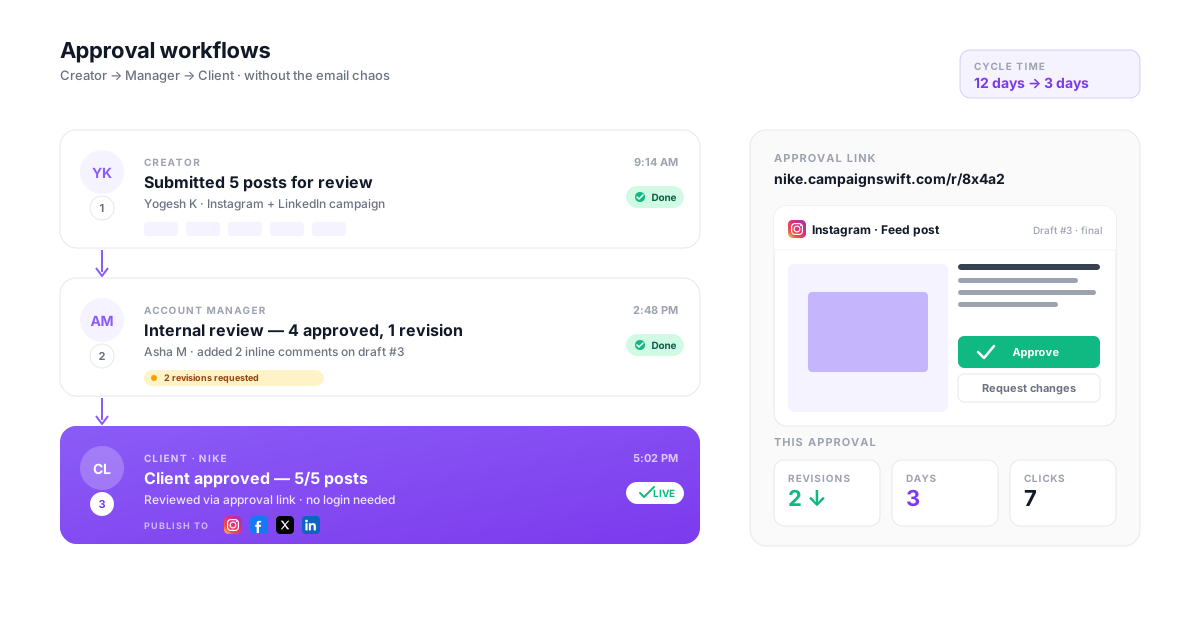
Break your approval process into distinct stages: internal team review, manager sign-off, and client approval. Each stage has clear entry and exit criteria. Content does not advance to the next stage until the previous one is complete. This prevents the chaos of simultaneous, conflicting feedback from different levels. Internal review catches most issues before the client ever sees the work, which means fewer client-facing revision cycles and a more polished first impression.
- Internal review catches errors early
- Manager sign-off ensures brand consistency
- Client sees polished work first time
- Clear stage gates prevent confusion
Structured Feedback Forms
Replace open-ended email feedback with structured review forms that guide reviewers through specific aspects of the content: messaging accuracy, brand alignment, visual quality, and compliance requirements. When reviewers are prompted to evaluate specific elements rather than writing free-form opinions, feedback becomes actionable on the first pass. Structured feedback sharply reduces ambiguity and eliminates the back-and-forth clarification emails that inflate revision counts.
- Guided review templates by content type
- Specific actionable change requests
- Eliminates vague feedback like 'make it pop'
- Side-by-side version comparison
Client Review Portals with No-Login Access
Send clients a secure, shareable review link that requires no login, no account creation, and no app download. The client clicks the link, sees the content in context, leaves inline comments directly on the asset, and clicks approve or request changes. The entire review takes minutes instead of days. No-login review portals eliminate the friction that causes clients to delay approvals. When reviewing is effortless, turnaround times drop from days to hours.
- One-click secure review links
- No account or login required
- Inline commenting on assets
- Mobile-friendly review experience
Role-Based Permissions and Approval Authority
Define exactly who can approve what within your workflow. Junior team members can submit for review but cannot approve. Account managers approve internally before sending to clients. Client contacts are assigned specific approval authority. The marketing manager approves social content while the VP approves campaign strategy. Role-based permissions prevent the conflicting-feedback problem and ensure the right people review the right content at the right stage.
- Tiered approval authority levels
- Prevent unauthorized approvals
- Route content to correct reviewers
- Automatic escalation for overdue approvals
Automated Reminders and Deadline Tracking
Set approval deadlines for each stage and let automated reminders do the follow-up. When a review is assigned, the reviewer gets an immediate notification. If they have not responded within 24 hours, a reminder fires. At 48 hours, an escalation alert goes to their manager. Your team never has to chase approvals manually again. In a typical agency, automated reminders take approval turnaround from days down to hours without any human follow-up effort.
- Automatic notifications on assignment
- 24-hour and 48-hour reminder sequences
- Manager escalation for overdue reviews
- Deadline visibility across all projects
Complete Audit Trail and Version History
Every comment, approval, rejection, and revision is logged with timestamps and attribution. When a client asks why a campaign launched with specific messaging, you can show the exact approval chain. When a stakeholder claims they never saw the content, the audit trail proves otherwise. Version history lets anyone compare any two versions side by side and see exactly what changed. This level of transparency eliminates disputes, protects your agency legally, and builds client trust.
- Timestamped approval records
- Full comment and revision history
- Side-by-side version comparison
- Exportable audit reports for compliance
Implementing Multi-Stage Review Workflows
A 4-step process to eliminate approval chaos in your agency
Map Your Current Approval Bottlenecks
Audit your last 20 content pieces and track how many revision cycles each one went through, where delays occurred, and which stakeholders caused the longest hold-ups. You will likely discover that 2-3 specific friction points account for 80% of your delays: typically unclear initial briefs, missing stakeholder alignment, or email-based review processes. This data tells you exactly where to focus your workflow redesign.
Define Stages, Roles, and Deadlines
Design your approval pipeline with 3 core stages: internal quality review, account manager approval, and client sign-off. Assign specific people to each stage with clear role-based permissions. Set time limits for each stage: 24 hours for internal review, 48 hours for client approval. Document the criteria for advancing content from one stage to the next. When everyone knows their role and timeline, ambiguity disappears.
Set Up Centralized Review with Structured Feedback
Replace email-based approvals with a centralized review platform where all content, comments, and approvals live in one place. Configure structured feedback forms tailored to each content type: social posts need different review criteria than blog articles or ad creative. Enable inline commenting so reviewers can point to exactly what needs to change. Send no-login review links to clients so approval is frictionless.
Automate Reminders, Track Metrics, and Iterate
Turn on automated reminders and escalation workflows so no approval request goes unanswered. Track key metrics: average approval time per stage, number of revision cycles per content type, and bottleneck frequency by stakeholder. Review these metrics monthly and adjust your workflow. Agencies that actively optimize their approval process typically see revision cycles drop by half within a couple of months.
Agency Approval Workflow Transformations: Illustrative Scenarios
Illustrative composites of how agencies eliminate approval bottlenecks (your numbers will vary)
Social Media Agency: Email Chaos to Structured Flow
12-person social media agency managing 30+ client accounts with approvals happening entirely over emailEvery social post required client approval via email. Approval requests got buried in inboxes, causing an average 4-day delay per batch. Designers received vague feedback like 'make it more engaging' and went through 5-6 revision cycles per post. The team spent 15 hours per week just chasing approvals and clarifying feedback. Two campaigns launched late in a single month, damaging client relationships.
Implemented a 3-stage approval workflow: internal creative review, account manager sign-off, then client approval via no-login review links. Structured feedback forms replaced open-ended email responses. Automated reminders eliminated manual follow-up. Clients reviewed and approved batches of 10-15 posts in a single session instead of one-off email replies.
Full-Service Agency: Stakeholder Conflict Resolution
20-person agency where campaign content required approval from 4 different client stakeholders who frequently gave conflicting feedbackThe client's marketing director, brand manager, legal team, and CEO all reviewed content simultaneously and often contradicted each other. The designer would implement the marketing director's feedback only to have the CEO request the opposite change. Projects averaged 7 revision cycles with conflicting direction. Team morale suffered as creatives felt their work was being pulled in impossible directions.
Implemented sequential role-based approvals: brand manager reviews first for guidelines, marketing director for strategy, legal for compliance, and CEO for final sign-off. Each reviewer only saw content after previous approvals were complete. Conflicts were resolved at each stage before content moved forward. Clear approval authority meant one person's sign-off at each stage was final.
Digital Marketing Agency: Client Portal Adoption
8-person agency whose clients consistently delayed approvals because the review process was too cumbersomeClients had to download attachments, open them in specific software, type up feedback in separate emails, and send them back. Most clients procrastinated on approvals because the process felt like work. Average client approval time was 6 days. The agency had a backlog of 40+ content pieces waiting for client feedback at any given time. Campaign timelines slipped by an average of 8 days per month.
Deployed no-login client review portals where clients clicked a link, saw content in context with preview mockups, left inline comments by clicking directly on the content, and hit a single approve button. The entire review took 5-10 minutes instead of 30-45 minutes. Automated 24-hour reminders ensured timely responses without the agency needing to follow up manually.
The Anatomy of an Effective Agency Approval Workflow
Why 5 Revision Cycles Is an Operational Failure, Not a Creative Standard
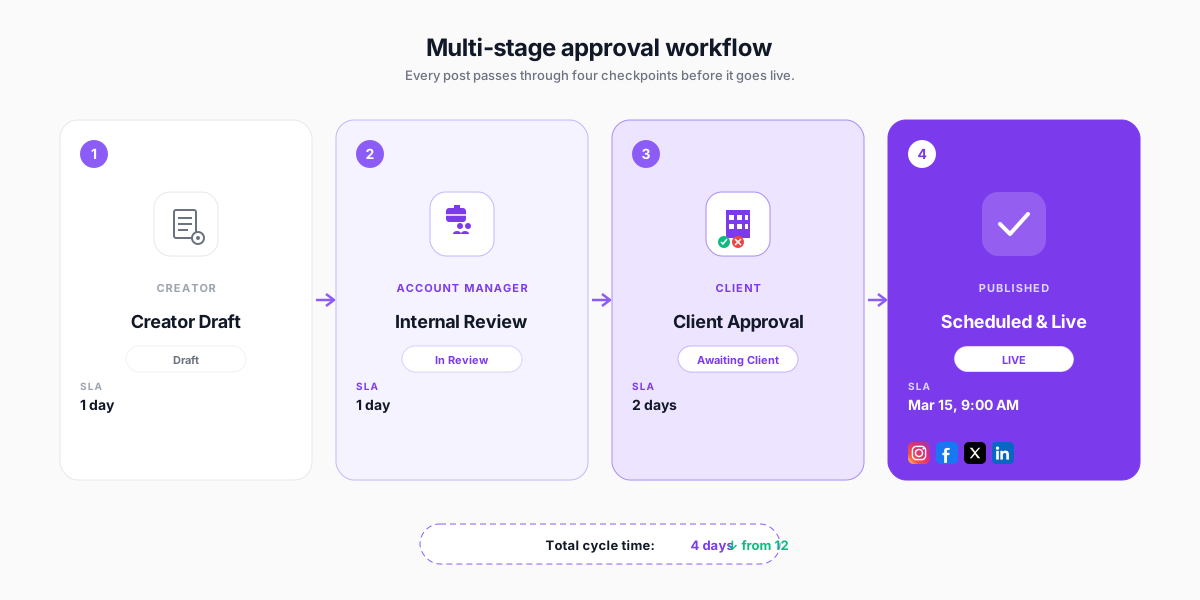
When a social media post goes through 5 revision cycles, the problem is rarely the quality of the creative work. It is the absence of structure around how feedback is collected, consolidated, and acted upon. In agencies averaging 5+ revisions per content piece, the majority of those revisions are caused by unclear feedback, contradictory stakeholder input, or reviewers seeing content at the wrong stage. A multi-stage workflow with structured feedback eliminates these root causes and can bring the average down to 2 cycles or fewer, without changing anything about your creative process.
Multi-Stage Review Process: Stage-by-Stage Breakdown
| Stage | Who Reviews | What They Check | Time Limit | Exit Criteria |
|---|---|---|---|---|
| 1. Internal Creative Review | Peer designer or copywriter | Grammar, visual quality, brand guidelines, asset specs | 4-8 hours | Zero quality issues; matches brief requirements |
| 2. Account Manager Sign-Off | Account lead or strategist | Strategy alignment, messaging tone, campaign consistency, client preferences | 12-24 hours | Content aligns with campaign objectives and client voice |
| 3. Client Approval | Client marketing contact | Final messaging accuracy, brand representation, legal compliance | 24-48 hours | Client clicks approve or submits specific change requests |
Each stage acts as a quality gate. Content only advances when the current reviewer approves it or when their requested changes are implemented and re-submitted. This sequential approach means the client never sees rough drafts, which dramatically reduces the number of client-facing revisions. Learn more about how social media approval software for agencies supports this stage-gate approach with no-login review links, tracked revisions, and automated follow-ups, typically delivered through a no-login client portal so clients review in two clicks without account creation friction.
Revision Cycles: Before vs. After Structured Workflows
The figures below are illustrative, based on the patterns we see across agency teams, not a formal study. Treat them as directional benchmarks for a typical mid-size agency.
| Metric | Without Structured Workflow | With Multi-Stage Workflow | Improvement |
|---|---|---|---|
| Average revision cycles per post | 4.8 revisions | 1.9 revisions | 60% reduction |
| Average time from draft to approval | 6.5 days | 1.8 days | 72% faster |
| Hours spent chasing approvals weekly | 12-15 hours | 1-2 hours | 85-90% less time |
| Missed campaign launch dates per month | 3-5 missed launches | 0-1 missed launches | 80% fewer delays |
| Team hours spent on feedback clarification | 8-10 hours/week | 1-2 hours/week | 82% reduction |
| Client satisfaction with review process | 5.2 / 10 | 8.7 / 10 | 67% higher |
The Feedback Loop Problem and How to Break It
Most agency revision cycles follow a predictable pattern of wasted effort. The designer creates content based on a brief. The client provides vague feedback. The designer interprets the feedback incorrectly. The client provides more feedback. This loop repeats until someone either compromises or runs out of time, a pattern we cover deeper in our analysis of agency client retention strategies, where unclear feedback drives client churn. Structured review processes break this loop at three points:
- Before the client sees it: Internal review catches the obvious issues (typos, wrong dimensions, off-brand colors) that waste a full revision cycle when the client flags them
- During the client review: Structured feedback forms force specific, actionable input instead of vague direction. Instead of "I do not like it," the client selects exactly which element needs changing and describes the desired outcome
- After feedback is received: Inline comments pinned to specific elements eliminate interpretation guesswork. The designer knows exactly what to change and where, getting it right on the first revision instead of the third
Calculating the Cost of Broken Approvals
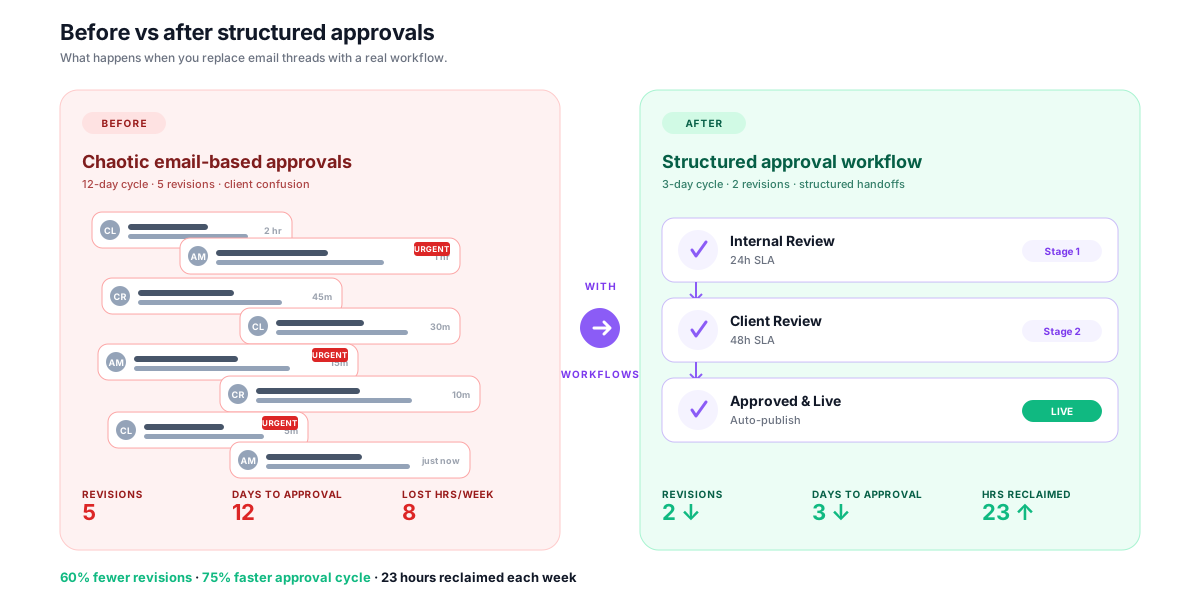
Consider an illustrative example: an agency producing 200 content pieces per month across all clients. At 5 revision cycles per piece with each cycle taking 30 minutes of designer time and 15 minutes of account manager time, that is 250 hours of revision work per month. At an average blended rate of $50/hour, broken approvals cost $12,500 per month in unbillable labor. Reducing from 5 cycles to 2 saves 135 hours and $6,750 per month, or $81,000 per year. That is the salary of a full-time team member, freed up by fixing a process. We break down the broader operational math in our piece on how agencies cut tool stack costs and scaling without burnout, both rooted in the same structural-system idea.
Why This Becomes Critical Past 15 Clients
The math above scales unfavorably. At 5 clients, you can patch broken approvals with heroics and Slack threads. At 15+ clients, you cannot. The agencies that grow past this point all have the same realization: approval workflow software stops being optional and becomes core agency management infrastructure. It is the single biggest reason teams move off scheduling-first tools, and our approval-focused Hootsuite alternative comparison walks through exactly where that gap shows up. Pair it with proper multi-client management structure and the operational overhead becomes manageable instead of crushing.
The operational pattern extends beyond just approvals. It ties to how you handle multi-client social media management generally and how your team handles unified inbox workflows across accounts. The agencies with the cleanest approval workflows almost always have the cleanest inbox and reporting workflows too, because it is the same operational discipline applied to different domains.
Stop Losing Hours to Approval Chaos
CampaignSwift's approval workflows give your agency a structured review process without the email chaos. No-login client review links, tracked revisions and version history, role-based permissions, automated reminders with optional auto-approve, and an Approval Shepherd agent that follows up on stalled sign-offs for you. Everything you need to cut revision cycles and reclaim hours every month.
Agency Approval Workflows: FAQs
Common questions about content approval processes for agencies
A content approval workflow is a structured process that defines how content moves from creation to publication. It specifies who reviews the content, in what order, what criteria they evaluate, and what happens at each stage. A typical agency approval workflow has three stages: internal team review where quality and brand consistency are checked, manager or account lead approval where strategy alignment is verified, and client approval where the final sign-off is given before content goes live. Without a defined workflow, approvals happen ad hoc and take significantly longer.
Agencies without structured workflows commonly go through 4-6 revision cycles per content piece, far more than necessary. With a well-designed multi-stage approval workflow, structured feedback forms, and clear role-based permissions, most agencies can get down to 1-3 revision cycles. The key difference is not that fewer people review the content. It is that feedback is clear, consolidated, and non-contradictory because each stage resolves issues before content advances to the next reviewer.
No-login review links are secure, shareable URLs that give clients direct access to review content without creating an account or downloading software. The agency generates a unique link for each review batch, and the client clicks it from any device: desktop, tablet, or phone. They see the content in context with preview mockups, can leave inline comments by clicking directly on specific elements, and approve or request changes with a single button. The link is time-limited and can be revoked, maintaining security without adding friction.
Role-based approval assigns specific permissions to different people in the approval chain. For example, a junior designer can submit content for review but cannot approve it. An account manager can approve internally but cannot publish. A client marketing manager can approve social posts but only the VP can approve campaign strategy documents. This prevents conflicting feedback from simultaneous reviewers, ensures the right expertise is applied at each stage, and creates clear accountability for every approval decision.
Start by removing friction from the review process: no-login review portals with one-click approval make it effortless for clients to respond. Set clear approval deadlines during onboarding and include them in your service agreement. Use automated reminder sequences: a notification when content is ready, a reminder at 24 hours, and an escalation at 48 hours. Track approval metrics and share them with clients during monthly reviews. Most client delays are caused by a cumbersome process, not a lack of willingness. When you make approval take 5 minutes instead of 30, turnaround improves dramatically.
Yes. Internal review before client review is one of the highest-impact changes you can make. When content goes through an internal quality check, covering brand guidelines, messaging accuracy, grammar, and visual quality, it arrives at the client in a polished state. This means fewer client revision requests, which reduces total revision cycles and makes your agency look more professional. Agencies that skip internal review and send drafts directly to clients tend to rack up far more revision cycles than those that run an internal review stage first.
Make the workflow the path of least resistance. If following the workflow is harder than sending an email, your team will send emails. Choose a platform where submitting content for review is faster than attaching a file to an email. Automate notifications so nobody has to remember to check a dashboard. Track compliance metrics and address bypasses immediately. Most importantly, show your team the data: when they see that structured workflows cut their revision workload in half, adoption follows naturally because the benefit is tangible and personal.
Yes. A well-designed approval system lets you create different workflow templates for different content types. Social media posts might need a 2-stage workflow with fast turnaround. Blog articles might require a 3-stage workflow including SEO review. Ad creative might need a 4-stage workflow that includes legal compliance review. Each template defines the stages, reviewers, feedback criteria, and deadlines appropriate for that content type. This ensures every piece of content gets the right level of review without over-engineering simpler deliverables.
Still have questions?
Our team is here to help. Book a 15-minute call to get all your questions answered.
Ready to put the busywork on agents?
Start with one client. Connect accounts, send your first approval link, and let the agents take the follow-ups. Plans start at $29/mo.
30-day free trial · No credit card · Cancel anytime
Questions? Book a 15-min demo call
Schedule Demo