Social Media Response Time Benchmarks for 2026
How fast should your agency respond to client DMs and comments? We compiled social media response time benchmarks across platforms and industries, combining our own platform data with platform-documented thresholds, to give you typical ranges to measure against, not vague advice like 'respond quickly.' These benchmarks reflect what audiences typically expect and what top-performing agencies deliver.

Why Response Time Matters More Than You Think
The business impact of slow social media responses
Customers Leave Before You Reply
01A potential customer asks about pricing in an Instagram DM. Three hours later, your community manager responds. By then, the person has already messaged two competitors and bought from the one that replied in 20 minutes. On social media, response time is a competitive advantage, not a customer service metric.
Algorithms Reward Active Conversations
02When someone comments on a post and gets a quick reply, the platform treats that as a signal of quality engagement. The conversation generates more visibility. Late replies break the thread. By the time you respond, the commenter has moved on and the algorithm has moved on with them.
Slow Responses Erode Client Confidence
03Your client checks their brand's Instagram and sees three unanswered DMs from yesterday. They do not care that your team was swamped with another account. What they see is their community being ignored. One email later, you are in a retention conversation you did not want to have.
Complaint Escalation Follows a Timer
04A customer posts a negative comment. If they get a response within 30 minutes, the situation usually stays private. After two hours without a reply, they post again, this time tagging the brand. After four hours, it becomes a public thread. After 24 hours, it might be a blog post. Every hour of silence is a multiplier on damage.
Social Media Response Time Benchmarks by Platform
What audiences expect and what top agencies deliver in 2026
X (Twitter): 15 to 30 Minutes
X has the shortest response time expectations of any major platform. The real-time nature of the feed creates an expectation of near-instant communication. Brands that respond within 15 minutes on X tend to see markedly higher satisfaction than those responding after an hour. For agencies, this means X DMs and mentions need dedicated monitoring during business hours.
- User expectation: under 30 min
- Top agencies: 12-18 min avg.
- Peak volume: 9 AM - 1 PM
- Highest escalation risk if slow
Instagram DMs: 1 to 3 Hours
Instagram users are slightly more patient than X users, but expectations have tightened over the past two years. In 2024, a 4-hour response was acceptable. In 2026, anything over 3 hours is considered slow. Story replies and DMs triggered by ads have the highest urgency. These are users in a buying mindset who reached out because something caught their attention.
- User expectation: under 3 hours
- Top agencies: 45-90 min avg.
- Ad-triggered DMs: respond faster
- Story replies: high purchase intent
Facebook Messages: 1 to 2 Hours
Facebook still displays response time badges on business pages. A 'Very Responsive' badge requires responding to 90% of messages within 15 minutes. While few agencies hit that mark for every client, the badge visibility means response time directly affects how potential customers perceive the brand. Pages without the badge often see lower message initiation rates.
- Responsive badge: < 15 min for 90%
- User expectation: under 2 hours
- Top agencies: 30-60 min avg.
- Badge impacts message volume
LinkedIn: 4 to 8 Hours
LinkedIn has the most forgiving response time expectations, reflecting its professional context. Users understand that LinkedIn messages are not urgent. That said, InMail responses and connection request follow-ups should still happen same-day. For B2B agencies managing client LinkedIn accounts, a 4-hour target is reasonable and achievable.
- User expectation: same business day
- Top agencies: 2-4 hours avg.
- InMail: same-day response
- Business hours only expected
TikTok Comments: 1 to 4 Hours
TikTok comment response timing has a unique dynamic. Responding to comments in the first hour of a post going live boosts the content's reach because the algorithm interprets active conversation as quality signal. After the initial window, standard response times of 2 to 4 hours are acceptable. But that first hour is gold for engagement.
- First hour: critical for reach
- Standard: 2-4 hours acceptable
- Creator replies boost algorithm
- Comment threads drive visibility
Google Reviews: Under 24 Hours
Google Business reviews are technically not social media, but agencies managing local clients cannot ignore them. Responding within 24 hours is the baseline. Negative reviews should get a response within 4 to 6 hours during business hours. Google's own local-ranking guidance encourages responding to reviews, and active review management correlates with stronger local visibility.
- Negative reviews: under 6 hours
- Positive reviews: under 24 hours
- Response rate affects local SEO
- Template responses are acceptable
How to Improve Your Agency's Response Time
Four steps to consistently hit your response time targets
Measure Your Current Baseline
Before setting targets, know where you stand. Pull response time data for each client and platform. Most agencies are surprised. They think they respond in an hour but the data shows 3 to 4 hours on average. Use this baseline to set realistic improvement goals.
Centralize Into a Unified Inbox
The single biggest improvement most agencies make is moving from native apps to a unified inbox. When your team works through one queue instead of checking seven platforms separately, response time typically drops sharply. A 40 to 60% reduction is a realistic range based on what we see across agencies. Messages stop hiding in tabs nobody checked.
Set Up Priority Routing and Alerts
Not every message needs the same response speed. Configure your system to flag urgent messages (complaints, purchase inquiries, high-follower accounts) and route them to senior team members. Set escalation timers so nothing sits idle past your target window.
Track, Report, and Adjust Weekly
Review response time data every week. Identify which clients are consistently slow (maybe they have higher volume than budgeted). Spot which team members need support. Share the data with clients in monthly reports. Fast response time is one of the easiest ways to demonstrate agency value.
Response Time Benchmarks in Practice
Illustrative scenarios: how agencies use these benchmarks to improve client results
E-commerce Agency
Managing social accounts for 12 DTC brands with high inbound message volumeAverage response time was 4.5 hours across all clients. Instagram DMs from ad traffic were getting responses after 6+ hours. The agency estimated they were losing 15-20 potential sales per week from slow DM responses alone, based on customers who messaged competitors after not hearing back.
After moving to a unified inbox with priority routing for ad-triggered DMs, average response time dropped to 52 minutes. Instagram DM response time for ad traffic hit 23 minutes. Two clients reported measurable increases in DM-to-purchase conversion rates within the first month.
Restaurant Group Agency
Handling social for 18 restaurant locations that receive daily reservation inquiries and complaintsFacebook messages averaged a 3-hour response time. Three locations had lost their 'Very Responsive' badge. Google review responses were sporadic: some got replies in a day, others sat for a week. Two locations had 1-star reviews with no response for over a month.
Automated routing sends reservation inquiries to a template-based quick response flow. Complaint messages trigger an immediate alert. All 18 locations regained the Facebook Responsive badge. Google reviews get same-day responses using approved templates.
B2B SaaS Agency
Managing LinkedIn and X for 8 B2B software clients where response quality matters as much as speedLinkedIn response time was acceptable at 5 hours, but X was a problem. Several clients' X accounts had unanswered mentions from two or three days ago. One client's prospect asked a product question via X DM and got a response 48 hours later, after they had already signed with a competitor.
X messages are now flagged as high-priority with a 30-minute escalation timer. LinkedIn stays at a comfortable 3-hour target. AI response suggestions help the team draft thoughtful replies faster, cutting average drafting time from 8 minutes to 2 minutes per message.
Social Media Response Time Benchmarks at a Glance
What audiences expect on each platform, and what the fastest agencies actually deliver.
| Platform | Users expect | Top agencies average | What makes it urgent |
|---|---|---|---|
| X (Twitter) | Under 30 minutes | 12–18 minutes | Highest escalation risk; peak volume 9 AM–1 PM |
| Instagram DMs | Under 3 hours | 45–90 minutes | Ad-triggered DMs and story replies carry purchase intent |
| Facebook Messages | Under 2 hours | 30–60 minutes | "Very Responsive" badge needs 90% answered within 15 min |
| TikTok comments | 1–4 hours | First hour where it counts | Replies in the first hour lift the post's reach |
| Same business day | 2–4 hours | Most forgiving; business hours only, InMail same-day | |
| Google reviews | Under 24 hours | Same day | Not social, but unavoidable for local clients |
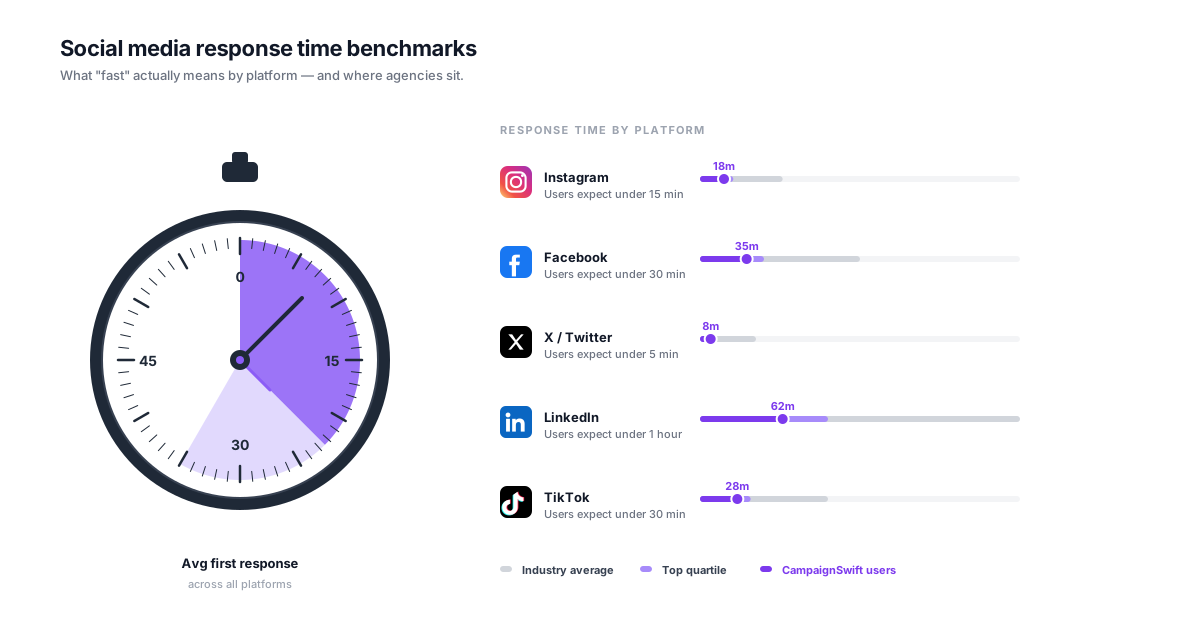
Expectations are audience-side norms, not platform SLAs. Across agencies using CampaignSwift the median response is about 2 hours 40 minutes, and the top 10% answer in under 35.
The Response Time Gap Between Average and Great
We track response time data across agencies using CampaignSwift, and the gap between average and top performers is wider than most people expect. The median agency responds to social media messages in about 2 hours and 40 minutes. The top 10% respond in under 35 minutes. That is not a small difference. It is the difference between catching a customer in buying mode and responding after they have already moved on.
What makes this data interesting is where the bottleneck actually sits. It is rarely about the quality or speed of the person typing the response. It is almost always about when they see the message. In a typical agency workflow without a unified inbox, a community manager checks Instagram, responds to what is there, switches to Facebook, responds, then moves to X. By the time they cycle back to Instagram 45 minutes later, new messages have been sitting unnoticed. Multiply that by 15 clients and the delay compounds fast, which is why agencies handling more than a handful of accounts usually move to dedicated multi-client management as the operational base.
Response time benchmarks summary (2026):
- X (Twitter): 15-30 minutes expected, top agencies at 12-18 min
- Instagram DMs: 1-3 hours expected, top agencies at 45-90 min
- Facebook Messages: 1-2 hours expected, top agencies at 30-60 min
- LinkedIn: 4-8 hours expected, top agencies at 2-4 hours
- TikTok Comments: 1-4 hours expected, first hour critical for reach
- Google Reviews: Under 24 hours, negatives under 6 hours
Using These Benchmarks With Your Clients
These numbers are most useful in two conversations. First, when setting expectations with new clients, you can show them industry benchmarks and commit to specific targets. "We will maintain a sub-60-minute average response time on Instagram and sub-30-minute on X" is a tangible promise backed by data. Second, in monthly reports through your agency reporting, showing that you are consistently beating the industry benchmark is a concrete way to demonstrate value beyond follower counts and engagement rates. We unpack the broader inbox workflow in our piece on how agencies handle social media inboxes at scale.
The agencies that consistently hit fast response times all share one thing: they work from a unified inbox instead of checking platforms individually. It is the structural change that makes speed sustainable, not just a heroic effort your team burns out maintaining. Talk to us if you want to see what your current response time baseline looks like and how to improve it.
Response Time Benchmarks FAQ
Common questions about social media response time standards
Commonly cited estimates put the average business response time on social media around 5 hours, though that number is skewed by businesses that rarely respond at all. Among businesses that actively manage their social presence, the typical average is closer to 2 to 3 hours. In our data across agencies using CampaignSwift, top performers consistently respond within 35 minutes to 1 hour.
Yes, indirectly. When you respond quickly to comments, the resulting conversation signals active engagement to the algorithm. On TikTok specifically, creator replies within the first hour of posting measurably boost content reach. On Facebook, response time affects the Responsive badge displayed on your page, which influences whether users message you at all.
Not necessarily every comment, but agencies should respond to every direct question, complaint, and purchase inquiry. For general comments like a single emoji or 'great post,' a like or brief acknowledgment is sufficient. The key is having a clear policy for each client about what gets a full response, what gets a like, and what gets ignored.
Most agencies define response time targets for business hours only, typically 8 AM to 6 PM in the client's timezone. Messages that arrive overnight get responded to first thing the next morning. Some agencies offer premium packages with extended hours or weekend coverage. Automated replies can acknowledge after-hours messages and set expectations for when a human will respond.
A unified inbox is the single biggest improvement. It eliminates tab-switching and ensures no messages hide in unchecked platforms. Beyond that, AI response suggestions speed up drafting and priority routing ensures urgent messages get seen first. CampaignSwift combines a unified inbox, AI-drafted replies you review before sending, automatic message classification and routing, and response-time tracking in one platform built for multi-client agencies.
Measure from when the message was sent (not when it was seen) to when your team sends a response. Exclude auto-replies from the measurement, since they acknowledge receipt but do not resolve the conversation. Track median response time rather than average, since one 24-hour outlier can skew an otherwise strong average. Break the data down by platform, client, and time of day.
Significantly. Retail and e-commerce see the fastest expected response times because customers are often mid-purchase. Healthcare and financial services have slower expectations but higher stakes per message. Hospitality and restaurants need fast responses for reservations and complaints. B2B companies have more relaxed timelines but higher expectations for response quality.
Customer satisfaction drops sharply after the 1-hour mark, and keeps falling with every additional hour of silence. After 4 hours, the odds of a positive outcome from the interaction fall dramatically. After 24 hours, many customers have already posted publicly about their negative experience or taken their business to a competitor who replied faster.
Still have questions?
Our team is here to help. Book a 15-minute call to get all your questions answered.
Ready to put the busywork on agents?
Start with one client. Connect accounts, send your first approval link, and let the agents take the follow-ups. Plans start at $29/mo.
30-day free trial · No credit card · Cancel anytime
Questions? Book a 15-min demo call
Schedule Demo