AI Social Media Strategy for Agencies That Actually Ship
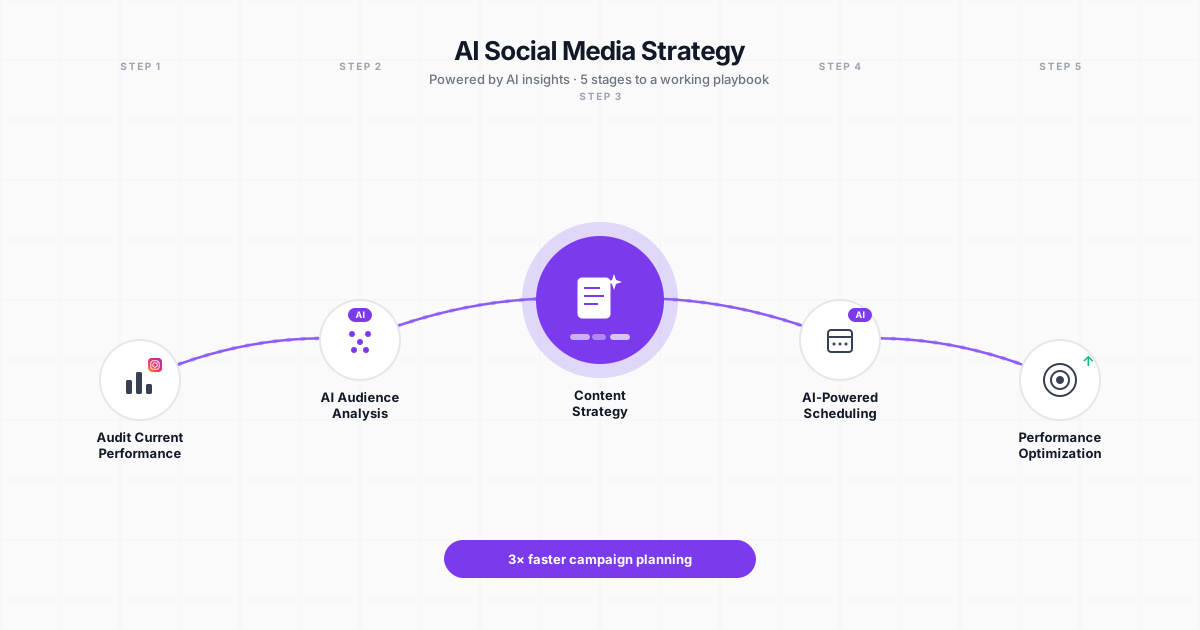
Most agencies treat AI as a shiny add-on. The ones growing fastest have built an AI social media strategy into their daily process: content creation, scheduling, analytics, reporting, even community management. This is how they do it, step by step, without turning their feed into generic AI slop.

Why Most AI Social Media Strategies Fail
The mistakes that waste budget and erode client trust
Dumping AI Content Without a Workflow
01An agency buys an AI writing tool, generates 200 captions in an afternoon, and schedules them all. Two weeks later, the client calls asking why their Instagram sounds like a press release. AI without a review process produces volume, not value. The output needs to fit into an existing quality workflow, not replace it.
Treating Every Client Like the Same Brand
02Most AI tools default to a single tone: upbeat, professional, slightly bland. That works for one client. It falls apart when you're managing a craft brewery, a B2B SaaS company, and a pediatric dentist from the same dashboard. Each account needs distinct prompt engineering and voice guidelines.
Automating the Wrong Tasks
03Agencies burn months trying to automate creative strategy or client communication with AI. Meanwhile, the real time sinks (pulling analytics data, formatting reports, resizing images, drafting initial copy) go untouched. The biggest wins come from automating boring repetitive work, not the parts that require human judgment.
No Measurement Loop
04You added AI to your workflow six months ago. Is it actually saving time? Is content quality the same? Better? Worse? Most agencies can't answer because they never established a baseline. Without before-and-after metrics, AI adoption is just a guess dressed up as innovation.
Where AI Fits Into Your Social Media Strategy
Six areas where AI delivers real time savings for agency teams
Content Creation Acceleration
AI generates first-draft captions, blog outlines, video scripts, and ad copy in minutes. Your writers aren't replaced. They shift from staring at blank pages to editing and refining drafts that already capture the core message. One agency we talked to went from producing 50 posts per week to 160 with the same three-person content team.
- First drafts in under 60 seconds
- Platform-specific formatting
- A/B copy variations on demand
- Brand voice templates per client
Scheduling Optimization
Generic 'best time to post' advice ignores that your client's audience in Austin behaves differently than the one in Melbourne. AI analyzes each account's historical engagement data and suggests posting times based on when that specific audience is active and engaging. The difference between a good time and a great time can be a meaningful jump in reach.
- Account-specific timing data
- Timezone-aware scheduling
- Day and hour optimization
- Auto-adjustment as patterns shift
Analytics and Trend Detection
Instead of spending Friday afternoon manually pulling numbers from five platforms, AI aggregates cross-channel data and highlights what changed. Which posts outperformed? Where did engagement drop? Are there early signs of audience fatigue? AI surfaces the signal. Your strategist interprets what it means and what to do next.
- Cross-platform data aggregation
- Anomaly and trend detection
- Audience behavior shifts flagged
- Automated weekly summaries
Reporting That Writes Itself
Monthly client reports often consume 3-5 hours each when done manually: logging into platforms, exporting CSVs, building slides, writing commentary. AI pulls the data, generates the visualizations, and drafts performance summaries. Your account manager reviews and adds strategic context. A 4-hour report becomes a 45-minute review.
- Auto-generated report drafts
- Client-ready visualizations
- Performance narrative generation
- White-label formatting
Community Management at Scale
When you manage 20 accounts, each getting 50+ comments daily, it's physically impossible to respond thoughtfully to every one. AI triages incoming messages: routine questions get draft responses for quick approval, negative sentiment gets flagged for immediate attention, and spam gets filtered out automatically.
- Sentiment-based message routing
- Draft replies for routine questions
- Spam and bot filtering
- Escalation rules for sensitive topics
Competitive Intelligence
Manually tracking what competitors post is tedious and inconsistent. AI monitors competitor accounts, tracks their posting frequency, engagement rates, content themes, and hashtag strategies. When a competitor shifts their approach or a new player enters the space, you know about it before your client asks.
- Automated competitor tracking
- Content theme analysis
- Engagement benchmarking
- Share of voice reporting
Building an AI-Powered Social Strategy
A practical rollout plan, not a wishlist
Map Your Current Process
Document exactly how content moves through your agency today, from brief to published post. Note every step, who does it, and how long it takes. You'll find that 30-40% of the process is repetitive work that AI handles well: drafting, scheduling, data pulling, report formatting. Those are your starting points.
Configure AI for Each Client
Set up brand voice guidelines, example posts, tone descriptions, and audience context for every client account. This takes 30-60 minutes per client upfront but determines whether AI output sounds like your client or like a generic marketing blog. Skip this step and you'll waste more time editing than you saved generating.
Run AI and Manual Side-by-Side
For two weeks, produce content both ways, AI-assisted and manual. Compare output quality (client approval rates), production speed (hours per deliverable), and engagement metrics. This gives you hard data on what works and what needs adjustment before you commit fully.
Integrate Into Daily Workflow
Once you've validated the results, make AI-assisted workflows the default. Your team's daily standup shifts from 'who's writing what' to 'who's reviewing and refining what.' Build AI into your project management templates, approval chains, and delivery schedules.
AI Social Strategy in Practice
Illustrative scenarios of how agencies at different stages use AI in daily workflows
5-Person Boutique Agency
Managing 12 clients across Instagram, LinkedIn, and Facebook with a lean teamThe founder wrote most client content personally because junior staff couldn't match the quality. Bottleneck on one person meant clients waited 3-4 days for content batches. The founder worked 60-hour weeks and was approaching burnout.
AI generates initial content batches using client-specific voice templates. The founder reviews and refines in 20 minutes what used to take 3 hours to write from scratch. Junior staff handle scheduling and community management with AI-assisted replies.
Mid-Size Performance Agency
Running paid social and organic for 35 clients with a team of 18Three account managers spent the first week of every month building reports. Analytics data lived in spreadsheets that broke when platform APIs changed. The team was always behind on reporting, which delayed strategy conversations with clients.
AI-powered reporting pulls data automatically and generates draft reports overnight. Account managers spend 45 minutes reviewing and adding strategic commentary instead of 4 hours building from raw data. Strategy meetings happen on the 2nd of the month, not the 10th.
Agency Scaling to Enterprise Clients
Adding Fortune 500 accounts that require detailed competitive intelligence and rapid responseEnterprise clients expected daily competitive briefings and near-real-time community monitoring. The agency assigned a dedicated analyst per account, which was expensive and not scalable. During one client's PR incident, the team didn't catch negative sentiment for 6 hours.
AI monitors competitor activity and generates daily briefings automatically. Sentiment analysis runs continuously with instant alerts for negative spikes. The dedicated analyst now covers three accounts instead of one, focusing on interpretation rather than data gathering.
The AI Strategy Stack: What Goes Where
We've talked to dozens of agency teams about how they use AI, and the ones getting real results tend to organize their AI usage into three tiers. Not every task deserves the same level of AI involvement.
| Tier | AI Role | Examples | Human Involvement |
|---|---|---|---|
| Tier 1: Full Automation | AI handles end-to-end | Data aggregation, report formatting, scheduling optimization, spam filtering | Spot-check weekly |
| Tier 2: AI Draft, Human Edit | AI produces first version | Captions, ad copy variations, comment replies, performance summaries | Review and refine every output |
| Tier 3: Human Only | AI provides data, human decides | Creative strategy, client calls, crisis response, campaign concepts, pricing discussions | Full ownership |
The tier system prevents the two most common AI failures: over-automation (letting AI handle things it shouldn't) and under-adoption (only using AI for one or two tasks when it could help across the board). A common split is roughly a quarter of social media work in Tier 1, close to half in Tier 2, and the rest in Tier 3, but run your own audit rather than assuming.
Quick self-assessment: Is your AI strategy working?
- Can your team produce 2x the content with the same headcount? If not, your content creation tier needs work.
- Are client reports delivered in the first 3 days of the month? If not, your reporting automation has gaps.
- Does your team know within 30 minutes when sentiment turns negative? If not, your monitoring setup needs attention.
- Can a new team member produce on-brand content within their first week? If not, your voice templates need refinement.
The Content Velocity Equation
One practical way to weigh AI's impact on your content operation is to time the workflow. Before AI, a typical agency content workflow looks like this: Brief (15 min) + Research (20 min) + Write (45 min) + Edit (15 min) + Schedule (10 min) = 105 minutes per post.
With AI integrated: Brief (15 min) + AI Draft (1 min) + Human Refine (15 min) + Edit (10 min) + AI Schedule (1 min) = 42 minutes per post. That's a 60% reduction, which means your team can either produce 2.5x more content or spend the recovered time on strategy and client relationships.
The math works differently for every agency, but the pattern is consistent. AI compresses the middle of the workflow, the writing and scheduling, while the bookends (briefing and strategic editing) stay human. Run your own numbers. If the time savings justify the tool cost and the learning curve, it's worth adopting. If not, wait until your volume warrants it.
Build Your AI Social Strategy in CampaignSwift
CampaignSwift puts AI content generation, an AI Copilot that drafts and schedules posts on request (every change proposed first, run only after you confirm), AI social media analytics, and white-label reporting in one platform, so your AI strategy isn't spread across five different tools. We dig deeper into specific use cases in our AI social media marketing guide. Check the pricing page to find the right plan for your team.
AI Social Media Strategy: FAQ
Common questions about using AI in your agency's social strategy
A tool is software. A strategy is how you use it. Having an AI caption generator doesn't mean you have an AI strategy. A strategy defines where AI fits in your content creation, scheduling, analytics, and reporting workflows, and where it doesn't. The agencies seeing the best results treat AI as a workflow decision, not a software purchase.
As a rough rule of thumb, a team of 5 managing 15-20 clients might save 15-25 hours per week after a 6-8 week optimization period. The biggest savings tend to come from content drafting, reporting, and daily scheduling work. The savings are real, but they take time to materialize as your team learns the workflows, and your numbers will depend on your starting process.
Content that's fully AI-generated with no editing tends to underperform on engagement. Audiences scroll past generic copy. Content that's AI-drafted and human-refined performs on par with (and sometimes better than) fully human-written content, because the AI generates more variations to test. The editing step is not optional.
Set up a brand voice profile for each client that includes tone descriptors, vocabulary preferences, phrases to avoid, example posts they've approved, and audience context. Feed this into your AI tool as system-level instructions. Then treat every AI draft as a first draft that your team refines. Good voice profiles get the output most of the way there; human editing closes the rest of the gap.
Most agencies find transparency works better than secrecy. Frame it as 'we use AI-assisted workflows to produce more content and analyze data faster, which means your team gets more output for the same budget.' Clients care about results, not whether a first draft was written by a human or a machine. They do care about quality, so the human review step matters.
Start with the team member who's most overwhelmed. Show them how AI handles the specific task they hate most, usually report building or caption drafting. When one person starts saving 5 hours a week, the rest of the team pays attention. Forcing agency-wide adoption by mandate creates friction. Letting it spread through demonstrated results works better.
Standalone tools (ChatGPT, Jasper, etc.) generate content in isolation. CampaignSwift's AI is integrated into the full workflow: the AI Copilot and Content Suggestion agent draft on-brand posts grounded in each client's voice and goals, drafts flow into approval chains, and reporting pulls from actual performance data. Every change the AI makes is proposed first and runs only after you confirm. It's the difference between having an AI assistant and having AI built into your operating system.
Predictive content scoring (knowing what will work before publishing), real-time audience segmentation, automated A/B testing at scale, and cross-platform content adaptation (turning one piece into platform-native formats for Instagram, LinkedIn, TikTok, and X). The agencies investing in these capabilities now will have a significant advantage in 12-18 months.
Still have questions?
Our team is here to help. Book a 15-minute call to get all your questions answered.
Ready to put the busywork on agents?
Start with one client. Connect accounts, send your first approval link, and let the agents take the follow-ups. Plans start at $29/mo.
30-day free trial · No credit card · Cancel anytime
Questions? Book a 15-min demo call
Schedule Demo