AI in Social Media Marketing 2026: Hype vs. Reality
Every vendor claims AI will transform your agency overnight. Most of it is marketing theater. This is an honest breakdown of what AI actually does well in social media marketing today, where it still falls short, and how to adopt it without wasting budget on empty promises.

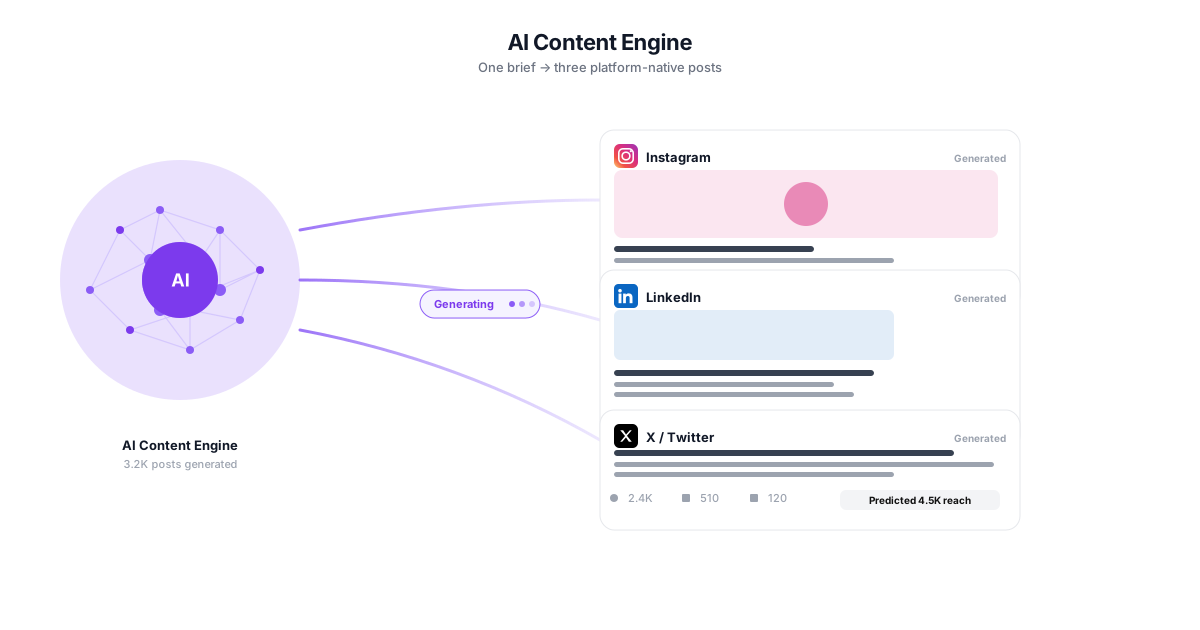
The AI Hype Problem in Social Media
Why most agencies are disappointed after buying AI tools
Feature Theater Over Function
01Vendors demo impressive AI capabilities in controlled environments with cherry-picked examples. In production, the AI generates generic captions, hallucinates metrics, or requires so much human editing that it saves no time. You end up paying premium prices for glorified autocomplete.
The 'Set It and Forget It' Lie
02AI marketing tools promise autonomous posting and engagement. Reality: unsupervised AI posts brand-damaging content, responds inappropriately to sensitive comments, and optimizes for vanity metrics instead of business outcomes. Every agency that tried full automation has a horror story.
One-Size-Fits-All Models
03Most AI tools are trained on general internet data, not your client's specific industry, audience, or brand voice. The result is content that sounds like every other brand online, technically correct but completely generic. Your clients hired you for differentiation, not sameness.
Integration Complexity Ignored
04Adding AI to existing workflows sounds simple in sales demos. In practice, teams spend weeks configuring prompts, training models on brand guidelines, and rebuilding approval processes. The productivity gains are real but take 2-3 months to materialize, not the instant results vendors promise.
What AI Actually Does Well for Agencies
Six capabilities where AI delivers measurable value today
Caption and Copy Generation
AI excels at producing first-draft captions, ad copy variations, and post ideas at scale. It won't replace your copywriter, but it eliminates the blank-page problem and can cut drafting time by half or more. The key is using AI for volume and variety, then having humans refine for brand voice.
- First drafts in minutes, not hours
- A/B copy variations in seconds
- Multilingual adaptation
- Writer's block eliminated
Hashtag and Keyword Intelligence
AI analyzes millions of posts to identify which hashtags drive actual reach vs. vanity impressions. It tracks trending topics in real-time and suggests hashtag combinations optimized for discoverability. This replaces hours of manual hashtag research with data-driven recommendations.
- Real-time trend detection
- Performance-based suggestions
- Competitor hashtag analysis
- Reach optimization
Sentiment Analysis at Scale
Monitoring brand sentiment across thousands of comments and mentions is impossible manually. AI categorizes sentiment accurately (positive, negative, neutral) at scale, flags potential crises early, and tracks sentiment trends over time. This is where AI outperforms humans.
- Real-time comment monitoring
- Early crisis detection
- Trend tracking over time
- Multi-language support
Optimal Posting Time Prediction
AI analyzes historical engagement data across each client's audience to predict when posts will get maximum reach. Unlike generic 'best time to post' guides, AI models are specific to each account's actual audience behavior patterns and adjust as those patterns shift.
- Account-specific timing
- Day-of-week optimization
- Seasonal adjustment
- Cross-platform coordination
Content Performance Prediction
Before you publish, AI can estimate likely engagement based on content type, format, topic, and historical performance. It won't predict viral hits, but it reliably identifies content that will underperform, saving you from posting duds and letting you iterate before publishing.
- Pre-publish scoring
- Format recommendations
- Topic trend alignment
- Underperformer flagging
Response Suggestions for Engagement
AI generates contextually appropriate reply suggestions for comments and DMs, maintaining conversational flow while saving community managers significant time. It handles routine responses well and escalates complex or sensitive messages to humans automatically.
- Context-aware replies
- Tone matching
- Auto-escalation for sensitive topics
- Response time reduction
Practical AI Adoption Framework for Agencies
A four-step approach to integrating AI without the pain
Audit Your Time Drains First
Before buying any AI tool, track where your team actually spends time for two weeks. Most teams discover a large share of social media work is repetitive: writing similar captions across clients, compiling reports, scheduling posts, responding to routine comments. These are your AI targets, not creative strategy or client relationships.
Start With One High-Volume Task
Pick the single most repetitive, time-consuming task from your audit and apply AI there. Caption drafting is the most common starting point because results are immediately measurable. Run AI-assisted output alongside your normal process for two weeks. Compare quality, speed, and team satisfaction before expanding.
Build Human-AI Workflows
Design explicit workflows where AI handles volume and humans handle judgment. Example: AI generates 5 caption options, human selects and refines the best one, AI schedules at optimal time, human reviews engagement and adjusts strategy. Document these workflows so every team member follows the same process.
Measure and Expand Gradually
Track three metrics: time saved per task, output quality (client approval rates, engagement metrics), and team satisfaction. Only expand AI to a second task after proving ROI on the first. Agencies that rush to 'AI everything' burn out their teams on configuration and produce worse results than manual work.
AI in Action: Three Agency Scenarios
Illustrative scenarios modeled on common agency workloads
Multi-Client Caption Production
Agency managing 25 restaurant clients needs 5 posts per week per client, 125 captions weeklyTwo junior copywriters spending 30+ hours per week writing captions. Chronic bottleneck causing missed posting schedules. Quality inconsistent due to volume pressure and burnout.
AI generates first-draft captions using each restaurant's menu, specials, and brand voice guidelines. Copywriters shift to editing and refining: reviewing 125 drafts takes 8 hours vs. writing 125 from scratch.
Sentiment Monitoring Across Accounts
PR-focused agency tracking brand sentiment for 15 corporate clients across all social platformsManual daily review of comments and mentions across 60+ social accounts. Junior team members missing negative sentiment. Two client crises escalated because complaints weren't flagged for 48+ hours.
AI-powered sentiment analysis monitors all accounts continuously. Negative sentiment spikes trigger instant alerts. Weekly sentiment reports generated automatically instead of manually compiled.
Performance Reporting Automation
Growth agency producing monthly analytics reports for 40 clients with cross-platform dataAccount managers spending 3-4 hours per client per month pulling data from each platform, building slides, and writing performance summaries. Two full-time employees dedicated almost entirely to reporting.
AI pulls cross-platform data automatically, generates performance summaries highlighting key trends, and flags anomalies. Account managers review and add strategic commentary rather than compiling data.
AI Capabilities: What Works vs. What Doesn't
The biggest mistake agencies make is treating AI as universally capable. In reality, AI excels at pattern-based, high-volume tasks and struggles with anything requiring nuance, creativity, or human judgment. Here's the honest breakdown.
| Capability | AI Readiness | Reality Check |
|---|---|---|
| Caption Generation | Strong | Excellent for first drafts and variations. Needs human editing for brand voice. Can cut writing time by half or more. |
| Hashtag Suggestions | Strong | Data-driven recommendations beat manual research. AI analyzes reach patterns humans can't process at scale. |
| Sentiment Analysis | Strong | Reliably categorizes sentiment at scale. Catches negative trends faster than any human team. Best AI use case. |
| Posting Time Optimization | Strong | Account-specific predictions outperform generic best-time guides. Adapts to audience behavior changes. |
| Performance Prediction | Moderate | Good at flagging likely underperformers. Cannot predict viral content. Useful for quality control, not crystal balls. |
| Response Suggestions | Moderate | Handles routine replies well. Struggles with sarcasm, complaints, and culturally sensitive topics. Needs oversight. |
| Brand Voice Consistency | Moderate | Improves with training data but never fully captures a brand's unique personality. Always needs human refinement. |
| Creative Strategy | Weak | AI can suggest formats and trends but cannot develop original creative direction. Strategy remains a human strength. |
| Relationship Building | Weak | Authentic community engagement requires empathy and personality. AI-managed relationships feel hollow and erode trust. |
| Crisis Management | Weak | AI detects crises early (strong). AI responding to crises is dangerous. Requires human judgment, empathy, and legal awareness. |
| Cultural Context | Weak | Misses regional nuances, subculture references, and evolving slang. Can produce tone-deaf content without human review. |
The Winning Formula: Human + AI
The agencies getting the most from AI aren't trying to automate everything. They're using AI for what it does best (processing data at scale, generating draft content quickly, and monitoring sentiment continuously) while keeping humans in charge of strategy, creativity, relationships, and judgment calls.
CampaignSwift's AI content generation is built on this principle. Every AI feature integrates into human approval workflows. AI drafts, humans decide. AI monitors, humans respond. AI predicts, humans strategize. That's not a limitation. It's the approach that actually works.
How to Evaluate AI Claims From Vendors
Before spending budget on any AI-powered social media tool, ask these questions to separate substance from hype:
- Show me production results, not demos: Demo environments use curated data. Ask for case studies with real metrics from agencies your size.
- What's the setup and training time? If the answer is "instant," be skeptical. Good AI tools require configuration. Honest vendors admit this.
- What happens when AI gets it wrong? Look for built-in human review steps, approval workflows, and escalation paths. Tools without guardrails are tools that will embarrass you.
- Can I see the AI's confidence scores? Mature AI tools show you how confident they are in each suggestion. Black-box tools that just output "the answer" are harder to trust and manage.
- How does it handle multiple brand voices? For agencies, this is critical. Generic AI that treats every client the same isn't built for agency workflows.
See AI That's Built for Agencies
CampaignSwift's AI features are designed for the reality of agency work: multiple clients managed through multi-client management, different brand voices, structured approval workflows, and team collaboration. No feature theater, just measurable time savings on the tasks that eat your team's hours. We explore the broader strategic frame in our AI social media strategy guide, and our piece on scaling agencies without burnout covers how AI fits into agency operations.
AI Social Media Marketing: FAQs
Honest answers to common questions about AI in social media
No. AI replaces repetitive tasks, not roles. The agencies seeing the best results use AI to handle volume (drafting, scheduling, data compilation) while humans focus on strategy, creative direction, client relationships, and judgment calls. Social media managers who learn to work with AI become significantly more productive. Those who ignore it will fall behind.
As an illustration, a five-person team that puts AI on caption drafting, report assembly, and routine replies might claw back 15-25 hours a week after a 2-3 month setup and optimization period. The biggest savings come from first-draft content, reporting automation, and routine response handling. Don't believe claims of 10x productivity. Real gains are meaningful but not magical.
Three approaches work: (1) Train AI with brand voice guidelines, example posts, and tone descriptions upfront. (2) Use AI for first drafts only, with human editing for brand alignment. (3) Build prompt templates per client that encode their voice. Most agencies find approach #2 delivers the best balance of speed and quality.
Prioritize: caption/copy generation, optimal posting time prediction, sentiment analysis, and automated reporting. Be skeptical of: autonomous posting without approval, AI-generated strategy recommendations, and 'AI-powered' features that are just basic automation rebranded. Ask vendors for case studies with measurable results, not demo screenshots.
Increasingly, yes, both by platforms and audiences. Fully AI-generated content tends to be generic and formulaic. The solution isn't to hide AI usage but to use AI as a starting point that humans refine. Content that's AI-drafted and human-edited is indistinguishable from fully human content and performs equally well.
CampaignSwift integrates AI into agency workflows rather than bolting it on. An AI Copilot reads your live account data and proposes actions (drafting posts, building reports, planning content) that run only after you confirm. Named agents handle the repetitive work: Inbox Triage drafts on-brand replies and routes complaints, Approval Shepherd chases stalled client sign-offs, and Reporting & Retention flags at-risk clients weekly. Content suggestions are grounded in each client's brand voice and past results. Nothing changes a client's account without human confirmation.
Avoid: (1) Automating everything at once. Start with one task. (2) Letting AI post without human review. (3) Paying for AI features you won't use within 90 days. (4) Expecting instant results. Plan for a 2-3 month learning curve. (5) Using AI to replace client communication or relationship building. (6) Choosing tools based on AI feature count instead of actual workflow fit.
AI excels at crisis detection: flagging sentiment spikes, unusual mention volumes, and negative keyword patterns faster than any human team. However, AI should never handle crisis response. Crisis communication requires empathy, legal awareness, organizational context, and strategic judgment that AI cannot reliably provide. Use AI as your early warning system, humans as your response team.
Still have questions?
Our team is here to help. Book a 15-minute call to get all your questions answered.
Ready to put the busywork on agents?
Start with one client. Connect accounts, send your first approval link, and let the agents take the follow-ups. Plans start at $29/mo.
30-day free trial · No credit card · Cancel anytime
Questions? Book a 15-min demo call
Schedule Demo