What Social Media Platform Pays the Most?
Creator earnings vary wildly depending on the platform, content format, and monetization model. We compared real payout data across YouTube, TikTok, Instagram, Facebook, X, and Snapchat (RPM ranges, fund sizes, and eligibility requirements) so you can make informed decisions about where to invest your time.

Why Platform Earnings Data Matters Right Now
The creator economy has matured, but the payout landscape is still confusing
The Creator Economy Is Estimated at $250+ Billion
01Industry analyses peg the creator economy at more than $250 billion, and more people earn a living from content creation than ever before. But most creators spread themselves across every platform without understanding which ones actually pay well for their content type. Knowing the numbers helps you focus where it counts.
Platform Payouts Vary by 10x or More
02A video that earns $50 on YouTube might earn $2 on TikTok. The same audience size on Instagram generates completely different revenue than on Facebook. These differences are not minor. They fundamentally change whether content creation is sustainable.
Ad Revenue, Creator Funds, and Sponsorships Are Different Games
03Some platforms share ad revenue directly. Others pool money into creator funds. Some offer no direct monetization at all, pushing creators toward brand deals. Each model has different ceilings, floors, and growth curves.
Agencies Need to Advise Clients on Monetization Strategy
04If you manage creators or brands with creator partnerships, you need to know which platforms deliver the best return per hour of content production. Advising a client to go all-in on a platform with declining payouts is a fast way to lose trust.
Social Media Platform Earnings Compared
Real payout ranges, eligibility requirements, and monetization models for each major platform
YouTube: The Highest Paying Platform for Long-Form
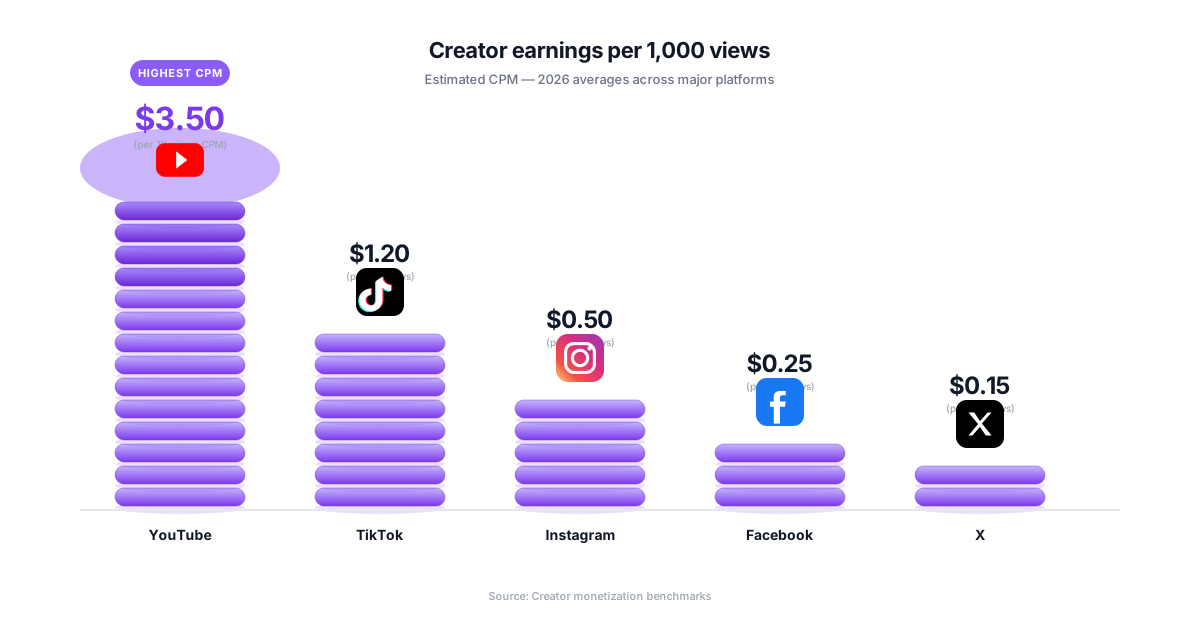
YouTube remains the gold standard for creator earnings. Through the YouTube Partner Program (YPP), creators earn a 55% share of ad revenue on their videos. CPMs typically range from $3 to $5 for general content, but can reach $15-30 in high-value niches like finance, insurance, and B2B software. Shorts monetization pays significantly less, roughly $0.01 to $0.06 per 1,000 views. To qualify for YPP, you need 1,000 subscribers and 4,000 watch hours (or 10M Shorts views) in the past 12 months.
- $3-5 CPM average (up to $30 in premium niches)
- 55% ad revenue share to creators
- 1K subs + 4K watch hours to qualify
- Highest long-form earning potential
TikTok: Creativity Program Pays Better Than the Old Fund
TikTok retired its original Creator Fund (which paid a notoriously low $0.02-0.05 per 1,000 views) and replaced it with the Creativity Program. The new program pays significantly more, roughly $0.50 to $1.00 per 1,000 qualified views, but it requires videos to be at least one minute long. Eligibility requires 10,000 followers, 100,000 views in the last 30 days, and the account must be in good standing. TikTok also offers live gifting, tipping, and a growing e-commerce integration as additional revenue streams.
- $0.50-$1.00 per 1K views (Creativity Program)
- Old Creator Fund paid $0.02-$0.05 per 1K views
- 10K followers + 100K views/30 days to qualify
- Additional revenue from live gifts and e-commerce
Instagram: No Direct Ad Share, But Strong Sponsorship Revenue
Instagram does not offer a traditional ad revenue share program for most creators. Income comes primarily from brand sponsorships, which range from $100 to $500 per post for micro-influencers (10K-50K followers) and $1,000 to $10,000+ for larger accounts. Instagram has offered Reels bonuses in the past, but these are invite-only and inconsistent, and Meta has scaled them back multiple times. The platform does offer Subscriptions (recurring fan payments) and Badges (live stream tips) as direct monetization options, though adoption remains limited.
- Sponsorships: $100-$500 (micro) to $1K-$10K+ (macro)
- Reels bonuses: invite-only, inconsistent availability
- Subscriptions and Badges for direct fan revenue
- No standard ad revenue share program
Facebook: In-Stream Ads and Reels Bonuses
Facebook offers in-stream ads for video creators, paying roughly $1 to $3 CPM depending on audience demographics and content category. To qualify, you need 10,000 page followers, 600,000 total view minutes in the past 60 days, and at least 5 active videos. Facebook has also run Reels bonus programs, though availability has fluctuated. The platform works best for creators with an older demographic (35+) where ad rates tend to be higher. Performance bonuses are less predictable than YouTube's consistent revenue share model.
- In-stream ads: $1-$3 CPM
- 10K followers + 600K view minutes to qualify
- Reels bonus programs (availability varies)
- Stronger ad rates for 35+ demographics
X (Twitter): Revenue Sharing for Premium Subscribers
X introduced ad revenue sharing for creators who subscribe to X Premium (formerly Twitter Blue). Payouts come from ads displayed in reply threads of verified creators. CPM equivalents vary widely, from roughly $0.50 to $5, depending on impressions and audience geography. The program requires an X Premium subscription, at least 500 followers, and 5 million organic impressions on posts in the past 3 months. Payouts have been inconsistent: some creators report meaningful income while others with similar engagement see minimal returns.
- $0.50-$5 CPM equivalent range
- Requires X Premium subscription
- 500 followers + 5M impressions/3 months
- Payout consistency varies significantly
Snapchat: Spotlight Fund and Story Revenue
Snapchat's Spotlight program pays creators for viral snaps, though the payout structure has shifted from its early days of massive bonuses (Snap initially allocated $1 million per day). Current payouts are lower and less predictable, based on performance metrics rather than guaranteed amounts. Snapchat also offers ad revenue sharing on Stories for eligible creators and has a gifting feature for live content. Overall earning potential is lower than YouTube or TikTok for most creators, but the platform can work well for specific demographics (13-24 age range) and ephemeral content styles.
- Spotlight pays for high-performing snaps
- Story ad revenue sharing available
- Lower overall payouts than YouTube/TikTok
- Best for reaching 13-24 age demographic
How to Maximize Earnings Across Platforms
A practical framework for choosing and optimizing your platform mix
Match Your Content Type to the Right Platform
Long-form educational or entertainment content earns the most on YouTube. Short-form viral content performs best on TikTok's Creativity Program. Visual lifestyle content drives sponsorship revenue on Instagram. Do not force your content style onto a platform that does not reward it. Pick the platform that naturally fits how you create.
Diversify Across 2-3 Platforms Strategically
Relying on a single platform is risky, because algorithm changes, fund reductions, and policy shifts can cut your income overnight. Repurpose your core content across 2-3 platforms, but invest the most effort into the one that pays best for your format. Use secondary platforms for audience growth and discovery.
Build Owned Audience Through Email and Your Website
Platform revenue is rented income. Build an email list and direct traffic to your own website where you control monetization through courses, memberships, affiliate marketing, or services. Every platform should funnel followers toward channels you own.
Use Analytics to Optimize Revenue Per Hour of Content
Track not just total revenue, but revenue per hour spent creating. A YouTube video that takes 8 hours to produce and earns $200 might be more efficient than 20 TikToks that take 10 hours total and earn $150. Use platform analytics and third-party tools to measure what is actually working.
Example Scenarios: Choosing the Highest Paying Platform
Illustrative scenarios of how different creators approach platform monetization decisions
YouTuber Evaluating Whether to Stay Long-Form
A creator with 50K YouTube subscribers earns $1,500-2,500/month from AdSense on long-form videos. They are considering shifting to TikTok Shorts because of faster growth.They see TikTok creators with millions of views and assume the money follows. Without checking actual payout rates, they start posting 30-second clips and reducing YouTube uploads. Revenue drops because Shorts and TikTok pay a fraction of what long-form YouTube ads generate.
After comparing CPM data, they realize their YouTube long-form content earns 5-10x more per view than TikTok. They keep YouTube as their primary revenue channel and use TikTok only for audience discovery, driving new viewers back to their YouTube channel for monetization.
TikTok Creator Evaluating the Creativity Program
A creator with 200K TikTok followers was earning $20-40/month from the old Creator Fund. They are considering applying to the new Creativity Program but are unsure if the format change is worth it.Under the old Creator Fund, their 15-second videos averaged 500K views but earned almost nothing. The $0.02-0.05 per 1K views rate made content creation economically unviable as a standalone income source.
By switching to 1-minute-plus videos for the Creativity Program, their per-view earnings jump to $0.50-$1.00 per 1K views. With 300K views per video, each piece of content now earns $150-300 instead of $10-25. The longer format also improves brand deal rates because sponsors prefer extended integrations.
Agency Advising a Client on Platform Strategy
A marketing agency manages a lifestyle brand that creates content across Instagram, YouTube, and TikTok. The client wants to know where to allocate their $5,000/month content production budget.Without earnings data, the agency splits budget evenly across all three platforms. The client produces the same number of posts everywhere, with no consideration for which platform delivers the best return. Resources are wasted on platforms that generate minimal direct revenue.
The agency uses analytics to track revenue per platform and recommends allocating 50% of budget to YouTube (highest ad revenue), 30% to Instagram (strongest sponsorship pipeline), and 20% to TikTok (audience growth and Creativity Program income). Quarterly reviews adjust the mix based on actual performance data.
How Agencies Help Clients Monetize Social Media
Understanding which social media platform pays the most is useful for individual creators, but for agencies managing multiple clients, especially those with creator partnerships or brand content programs, the question becomes more nuanced. It is not only about which platform pays the highest CPM. It is about which platform delivers the best return relative to the production cost, the client's audience demographics, and the overall content strategy informed by cross-platform agency reporting.
We have seen agencies waste months pushing clients toward platforms that look good on paper but do not match the client's strengths. A B2B software brand does not belong on TikTok's Creativity Program. A lifestyle creator targeting women aged 25-40 probably should not prioritize X. The right platform decision starts with audience data, not trending payout rates. That is where analytics tools become essential: they show you where a client's audience actually engages and converts, not just where they scroll.
What a platform monetization review looks like for agency clients:
- Pull 90 days of performance data across all active platforms: views, engagement rate, and revenue (if applicable)
- Calculate effective revenue per hour of content production for each platform
- Identify which platform drives the most downstream value (email signups, website traffic, conversions)
- Reallocate production budget toward the highest-performing channels with quarterly reviews
The agencies that do this well treat platform selection as a data-driven decision, not a gut feeling. They use unified dashboards to compare cross-platform performance, and they revisit the allocation every quarter because platform payouts and algorithms shift constantly. If you are advising clients on where to invest their content budget, having the right analytics infrastructure is non-negotiable. We unpack the broader landscape in our roundup of the best social media analytics tools for agencies. See how CampaignSwift helps agencies consolidate multi-platform analytics into one view.
Social Media Platform Earnings FAQ
Common questions about which platforms pay creators the most
YouTube consistently pays the most for long-form video content, with CPMs ranging from $3-5 on average and up to $15-30 in premium niches like finance and software. The YouTube Partner Program gives creators a 55% cut of ad revenue, which is the most transparent and scalable payout model available. For short-form content, TikTok's Creativity Program has become competitive at $0.50-1.00 per 1,000 views, though it still trails YouTube's long-form rates.
TikTok's old Creator Fund paid roughly $0.02 to $0.05 per 1,000 views, widely considered too low to be meaningful income. The newer Creativity Program pays significantly more, approximately $0.50 to $1.00 per 1,000 qualified views, but requires videos to be at least one minute long. Creators also need 10,000 followers and 100,000 views in the past 30 days to qualify.
Yes, for most content categories YouTube remains the highest paying platform. Its ad revenue share model (55% to creators) scales with viewership in a way that creator funds and bonus programs do not. A YouTuber with 100,000 views on a video can earn $300-500 or more, while the same view count on TikTok's Creativity Program would generate $50-100. The gap narrows for short-form content, but YouTube's long-form advantage persists.
Instagram offers Subscriptions (monthly fan payments) and Badges (live stream tips) as direct monetization, but these features have limited adoption. Instagram has also offered Reels play bonuses, though these are invite-only and have been inconsistent. For most creators, Instagram income without sponsorships is minimal. The platform functions primarily as a portfolio and discovery tool that drives brand deal opportunities rather than direct platform revenue.
Facebook in-stream ads typically pay $1 to $3 CPM, meaning $1 to $3 per 1,000 ad impressions on your videos. To qualify, you need 10,000 page followers and 600,000 total view minutes in the past 60 days. Earnings tend to be higher for audiences aged 35 and older, where advertiser competition drives up ad rates. Most full-time creators find Facebook earnings supplementary rather than primary.
X offers ad revenue sharing for creators who subscribe to X Premium. Revenue comes from ads shown in reply threads of your posts. The program requires 500 followers and 5 million organic impressions in the past 3 months. Payouts vary widely: CPM equivalents range from $0.50 to $5 depending on audience geography and engagement patterns. Some creators report meaningful monthly income, while others with similar metrics see very little.
TikTok offers the fastest path to visibility because its algorithm promotes content regardless of follower count. However, TikTok's monetization requires 10,000 followers. YouTube is harder to grow on initially but pays more once you reach the 1,000 subscriber threshold. For beginners, we recommend starting on TikTok for audience building while simultaneously uploading long-form content to YouTube for long-term revenue potential.
Agencies managing creator clients use analytics platforms to aggregate performance data across YouTube, TikTok, Instagram, and other channels. Tools like CampaignSwift pull engagement metrics, audience demographics, and content performance into unified dashboards, making it easier to compare revenue potential across platforms and advise clients on where to allocate their content production budgets.
Still have questions?
Our team is here to help. Book a 15-minute call to get all your questions answered.
Ready to put the busywork on agents?
Start with one client. Connect accounts, send your first approval link, and let the agents take the follow-ups. Plans start at $29/mo.
30-day free trial · No credit card · Cancel anytime
Questions? Book a 15-min demo call
Schedule Demo